Showing posts with label stream. Show all posts

Thursday, August 29, 2013

Repost: Fishing For Big Trout And Salmon in The Great Lakes

The salmon run is fast approaching, and this old blog post of mine has been getting a lot of traffic.  I'm doing something I've never done and recycling some old material to help my followers get ready for the salmon and steelhead run. 

First off, I've added a couple new pages, a little bio about myself, and a page with links to the official fishing websites for every state, and Canadian province.  This could be helpful if you're ever planning a multi state or international fishing trip.

A couple enjoys the view on Milwaukee's
north pier
Fishing for salmon and big trout is one of the reasons I love living so close to Lake Michigan.  If you've never seen one of the Great Lakes, they're big!  My Minnesotan wife still calls Lake Michigan "the ocean."  As I discussed in an earlier post, most trout and salmon aren't native here, so the Great Lakes might be a nice opportunity to get out on a stream and catch a nice chinook without going to Alaska.  Fishing out in the lake with a boat is the obvious way to go, but I don't have a boat, and I'm going to assume you don't either.


Mckinley Marina in Milwaukee
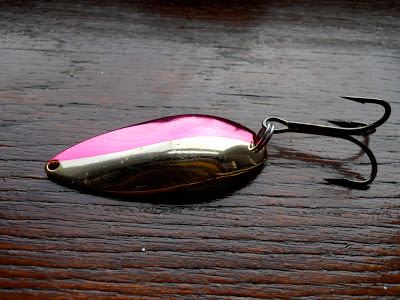
What you are going to want to do is find a pier, or some structure that allows you to get out in the lake.  I think the wall provides cover for smaller baitfish, and big fish come there to be treated to a buffet.  When fishing off the pier or even just off a wall into the bay in Milwaukee, I like to use big, heavy spoons that cast far and get down deep.  In my opinion, Acme Tackle makes the best spoons, with my favorites being the Little Cleo, The K.O. Wobbler, and the Kastmaster.  I've caught more salmon on Little Cleos than on anything else, I even mentioned the name Cleo for my daughter, but the wife shot that idea down.  I like the silver and blue ones for salmon.  I've never caught a steelhead, but I hear that orange is the hot steelhead color, and gold is good for big browns.  When fishing the lake, I'll use a heavier one, the 3/4 oz size casts further and sinks faster.  The Kastmaster also casts very far, it's not just a clever name.  With these lures, just cast as far as you can and wait while the lure sinks.  Retrieve the lure just fast enough to make it wobble, you'll feel it.  You can also use Wildeye Swimbaits or Rat-l-traps for trout and salmon in the lake.  There is no telling what else might bite those though.  Fishing in the lake is great fun, the bites might be few and far between, but there's something about sitting along our gorgeous glacial sea all day with a sandwich for lunch, and a beer or three that takes you far away from the world while a million people scramble in the city just a half a mile away, completely oblivious to what a beautiful resource we have.

I found this Kastmaster in some streamside bushes

little cleo, gold and red.
The Little Cleo is about the sexiest lure there is

beat up looking rat-l-trap
My Rat-l-trap has seen some action!

In about mid August, the salmon will start to move toward their natal stream. This time is the best opportunity to catch them in the lake, or even in the channel if they start to swim upstream.  Any change in the weather will make them start to move and then you can try to catch them in the streams.  It might just take a drop in temperature, or a little rain and a few overcast days to make them start running.  I've caught salmon in the middle of August in the White River in Michigan, but this year, I didn't see any salmon in the Menomonee until the end of September.  In the streams, I'll still use Little Cleos in deeper pools, but I may use a 2/3 or 2/5 oz instead of a heavier one.  They move a little more erratically in the current than a heavier one.  I will also use some diving crankbaits in the streams; Storm makes my favorites, and they're reasonably priced too.  The deep diving Thunderstick Jr. and the Hot 'N Tot are the ones I use most.  You will find that fishing in the stream can be very frustrating.  There are days when the salmon are so thick that you could walk across them, but they won't bite a thing, then other days, they'll bite anything!  If you're on the stream and salmon are flying out of the water like ballistic missiles from a Russian nuclear submarine, that is the day they will bite anything.  You will probably get splashed by salmon jumping, and they'll scare the hell out of you, but they are angry at everything in the water.  All you have to do is put something in the water with some hooks in it.  The best days always seem to be overcast and rainy days.  I've had the best luck in the evening on overcast and rainy days; not a really hard downpour, just a steady rain.  In both the stream and the lake, using ten pound test line is probably adequate.  I've seen guys use 20, but that's overkill.  This season, I used 6 pound test and I only had one salmon break my line.

three storm lures
Two Hot 'N Tots and a Wiggle Wart

My Thunderstick, marred by salmon teeth.  Note the
scale just behind the front hook.

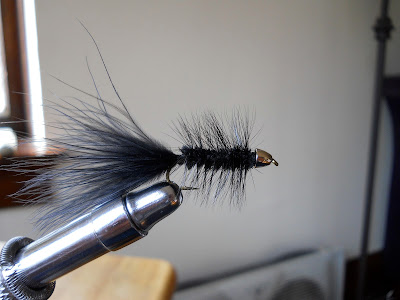
This is the first year I've ever spent a lot of time fly fishing for salmon.  I cut the tapered leader down to about three feet and just tied on about six feet of hybrid six pound test.  I used mostly Woolly Buggers, and egg sucking leeches.  I haven't had a chance to use my creation, the Force Choking Leech, very much.  You can find instructions on how to tie it here.  If you're a fly fisherman, you're probably better at it than I am, so I can provide very little instruction.

black and red egg sucking leech
Egg sucking leech with flashabou in the tail

black cat sniffs a streamer in the tying vise
Kittie examines my fly tying skills

black woolly bugger, silver cone head.
Probably the best looking bead head Woolly Bugger
I ever tied.
Salmon and trout can be hard to catch, but you'll remember your first one forever!  I fished for salmon for a few years before I caught my first one, It was October 1, 2002.  It takes time to learn how these fish work.  I can feel the change in the weather that brings the salmon into the streams now,  an instinct I can't explain.  The clouds look a certain way, the air has something different about it.  It took me years of fishing and lots of luck before I even had a salmon bite.  How bad do you want it?

Wednesday, December 12, 2012

Basic Fly Tying Techniques and Tying The San Juan Worm

When you first get started fly tying, there are two techniques that are the same for just about every fly, how you start the fly, and how you finish it.  Once you know how to do those two things, techniques can be learned on a case by case basis; mostly, it's just wrapping thread around stuff.

Getting the thread started on a hook is way simpler than you could ever imagine.  There is no tying involved, just wrapping thread.  To try to explain it would make it sound way more complicated than it ever is, so I demonstrate the technique in the following video.  Excuse the shaky cam,  I literally just set my Nikon L24 on a stack of books on a T.V. tray.


Finishing up the fly is more complicated.  The handbook that came with my kit teaches a knot that just does not hold unless cemented with head cement, and a lot of videos on Youtube showed guys tying a knot with a "Whip Finishing Tool."  I didn't have this tool, so I found instructions on how to whip finish by hand, but the videos were all done so fast that I couldn't clearly see what was being done.  My whip finish kept coming undone until I finally figured out where I was going wrong.  Now I whip finish by hand, and my knot holds just fine with no cement. In my opinion, the tool seems to overly complicate things.  To try to give written instructions on how to whip finish by hand would be hard to do, and even harder to follow--I know by experience--so here is a demonstrational video.


Ok, now with just those two techniques, some scud hooks, some thread, some chenille and a lighter, you are ready to tie the San Juan Worm.  I tried to do some research to find out a little background for this simple-yet-effective fly.  I wouldn't call it a streamer, it's not a wet fly, definitely not a dry-- It's more of a nymph than anything else, but it's not even really a nymph.  This link gives some interesting background information on the San Juan Worm.  I usually tie them with a size 12 or 14 scud hook with a downturned eye.  Scud hooks have a curved shank, rather than being straight.  Below is a three minute video demonstrating how to tie the San Juan Worm.


When fishing in a stream with a San Juan Worm, I cast to the head of a pool and let it dead drift through the pool.  They work well after the rain when worms get washed into the stream, I don't use them a lot, but when I do, I catch smallmouth bass.  I've never tried fishing for trout with them, but I don't really get to go trout fishing as often as I'd like to.  If you have any questions about tying flies, leave a message, I'll try to answer what I can.

Tuesday, November 20, 2012

Beers, Brothers and Broken Rods

Earlier in the fall, my wife accidentally slammed my only remaining spinning rod in the trunk of our VW.  Me, seeing that the dashboard lamp indicating that the trunk was ajar, opened the trunk and slammed my rod in it again.
To be honest, I did not care much for the rod.  It was a Shakespear Tiger Spinning rod, available exclusively at Walmart.  It was cheap, and it brought in a lot of fish.  The rod was cracked pretty severely just below the female ferrule, but it wasn't totally broken; I was going to fish with it until it met its end.
I'd prefer to fly fish, but I will not fly fish with my 8 month old daughter on my chest-- I don't trust my fly casting ability-- and most opportunities I have to fish are with her when I take her for walks.  Despite the damage, the rod still landed some serious salmon out of the Menomonee River!  But finally, in the end, it was a 22" coho that did it in.  I still landed the fish.


My brother has been trying to make a trip to our side of the lake since August, but a new position at his job made finding a free weekend unpredictable.  After my rod broke, I told my dad and he has more gear than he knows what to do with in his mancave.  He had a couple of old rods that he was going to send with my brother when he finally came.  Shane usually has his head in the clouds, but he likes to get on the water occasionally when he's not flying.  We were planning hitting the Milwaukee for smallmouth in the summer, but salmon are prevalent in the Menomonee even so late in the fall.

Me and Shane, 2009

Shane after flying an Extra 300

Magician Lake Bass trip, 2012

Shane showed up late friday, we went to Cafe Hollander for beers and conversation.  after the beers, we skipped stones in the river for way too long before calling it a night-- it's so much more fun after a couple beers.  The next morning, I swapped the reel on one of the rods my dad sent for my nicer one.  Shane, Lilyhammer and myself walked out the front door and hit the Menomonee while my wife stayed home.  We walked for a mile or so before we saw fish, and then it wasn't long before I had one on.  I instantly asked Shane if he wanted to land the fish-- He had never caught a salmon.  He said "I don't not want to land the fish," or something along those lines.  Lily and I readied the net, Shane took the line.  Shane eventually brought the fish to the to the net, the fish came ashore, pictures were snapped and the fish was released.

Shane's salmon

He wanted to see me catch one, but I couldn't get another fish to bite.  That's fine though, I've caught a dozen or so this season.  There will probably be a couple more before the weather gets really cold, and then there is the spring steelhead run!

Friday, August 24, 2012

The Straight Talk on Curly Tail Grubs


assorted curly tail grubs
My collection.
The first lure that every angler needs is the Mister Twister Curly Tail Grub.  Mister Twisters are very natural appearing soft plastic and the slightest movement in the water will cause lifelike motion in the tail.  You can get a package of 20 Mister Twisters for around $3.00, there are also variety packs with several colors.  You’ll need to buy jig heads as well but those are also super cheap.

Since you have to rig Mister Twisters yourself, they are highly customizable.  You can get heads painted in colors that stand out from the color of the lure, or heads that have eyes painted on them.  I usually get very small unpainted jig heads.  Mister Twisters come in many colors, with the most effective being chartreuse flake, pumpkin pepper, purple, and black, but they are all good.

three curly tail grubs
purple, pumpkin pepper,
and chartreuse flake.  I
ran all out of black.
When rigging, make sure the hook
goes the opposite way of
the tail.
Rigged like this, the tail is more
likely to get hung up 
on the hook.


The most amazing thing about Mister Twisters is that they catch just about anything!  Here is a list of fish I have caught on them.
  • Bluegill
  • Sunfish
  • Crappie
  • perch
  • rock bass
  • bullhead
  • creek chub
  • smallmouth bass
  • largemouth bass
  • northern pike
  • walleye
  • sucker
  • carp


When fishing in a bass stream or river, I like to use the smallest jig head I can cast.  Cast them up and across the current to the head of a deeper pocket, or just alongside cover likely to hold fish.  The lighter head makes the lure sink very slowly and naturally in the moving water.  I retrieve the line just fast enough to keep it tight while my lure bounces across the bottom, and if the line goes tight, set the hook!  In the Milwaukee, I’ve caught many smallmouth, some nice rock bass, one 24” carp, and even walleye using this method.  One day earlier this summer, my dad and I caught about 40 fish in the Milwaukee River in just a few morning hours.  My dad borrowed my spinning rod and used Mister Twisters, I used my fly rod and Woolly Buggers.  It was seriously like video game fishing!

Smallmouth on a hand tied Woolly Bugger while
fishing with dad.
One of dad's smallmouths on a
Mister Twister

Nice one!

Nice sized rock bass on the fly.
Beautiful fish.
Rock bass on a Mister Twister.
Chartreuse flake FTW!

When I lived in Michigan, I would fish the rocky walls of the Muskegon Lake Channel using Mister Twisters under a float with good success.  In this situation, a bigger jig head can be used.  The float would go about 4’ above the lure, then cast almost parallel to the rock wall.  The ebb and flow of the water between Lake Michigan and Muskegon Lake will keep your float and lure moving along the rocks while the waves give it vertical motion.  The lure will present itself to spaces between the rocks and dark hollows where panfish, largemouth bass and rock bass love to hide.  If your float disappears under the water, set the hook!  This technique also works along the rocks in Veteran’s Park in Milwaukee, or out on the rocky section of the breakwater, and even right in front of the Milwaukee Art Museum!  Don’t be afraid to climb out on the rocks, find one that looks fairly level and sturdy and make it your home.


A dreary summer day under the Art Museum

The wings of the museum close and open at noon.

This big perch took a black Mister Twister

The rocks along Veteran's Park with
the breakwater in the background.
So much cover for fish.

When I'm in Michigan, My dad, my brothers and I would go out in my dad’s fishing boat and fish in inland lakes.  Most of the time we’d go to Twin Lake on weekday evenings.  Twin Lake is close to home and not too big, so it doesn’t get a lot of fishing pressure during the week.  On the water, you simply cast your line out, then let the breeze push the boat.  You can give your lure some twitches by lifting the tip of your rod occasionally, but a lot of times, that isn’t even necessary.  Largemouth bass or northern pike won’t hesitate to suck up a purple Mister Twister just crawling by at a snail’s pace.  When Kyle, my youngest brother was just a little toddler, we wanted him to feel like he was fishing.  What we did was gave him a yard sale kid’s rod with a brown Mister Twister on a huge orange jig head (we called them “pumpkin heads”) and let his line drop about 8’ below the surface, just to make him feel like he was fishing.  The waves kept his lure moving up and down, and wouldn’t you know it, he caught the biggest bass of the day “pretending to fish.”  It must have been 17” long!  Poor little boy, it scared the crap out of him!  I still remember him crying out “Put that whale back!”  

Magician Lake.  Kyle's all grown up now.  My dad and my other
brother Shane in the background.

If you don’t have access to a boat, fishing from shore is still a lot of fun.  Cast toward docks, lily pads, downed trees, anything that gives fish cover.  You can also just cast out and steady retrieve your line back in, big bluegill will give chase!

Because of their affordable price and effectiveness for so many species, if you are only going to fish with one artificial lure, Mister Twisters are the one.  But i’m betting, once you get into fishing with artificials, you’ll be hooked!

Monday, July 30, 2012

Back to Basics


It’s not like I’m a bass pro or anything, but I have been fishing for as long as I can remember.  I’m serious about it, but mostly, I just want to have fun and enjoy being out in nature.  I usually practice catch and release, fish artificial bait as much as possible and I like to keep it cheap.  It is very easy to spend a lot of money on gear, but in my opinion, it’s more rewarding when you can fish effectively on minimum (or improvised) tackle.
A little introduction:  My wife is from Minnesota and I’m from Michigan, but we currently reside in Milwaukee, Wisconsin.  We just had a little girl, who I cannot wait to take fishing with me.  Maybe I can even get my wife to take an interest if our little one does!  We love music.  She is a piano player who has a degree in music, and I taught myself to play guitar.  I am studying to be a phlebotomist and am almost finished with school.
I used to have a lot of gear, but I was careless a few years ago and I left my stuff in the back of my truck after a fishing trip and it was all stolen!  Probably close to a thousand dollars in gear.  Several rod and reel combos, including a fly rod, several tackle boxes full of gear; one box I had just gotten that Christmas from my Dad.  A lot of the tackle was brand new and unused.  
Replacing so much lost gear was just unrealistic, but lost gear couldn’t deter me from getting back out on the lakes and streams.  I think I was out the next weekend.  When I replaced my fly rod I upgraded to a slightly better model because my first one was a beginner model.  I was given another rod and reel combo that I used until I destroyed the rod beyond repair.  So, I’m back to using my backup rod again (the only one that wasn’t in the truck) when I’m not fly fishing. It has been broken and repaired a few times.  It was the rod I was using when I caught the biggest fish of my life; a 38” 25 pound chinook (I’m sure I’ll tell the story in a later blog).  I never replaced the boxes, so I usually just limit my tackle to what I can carry in a smaller tackle box with the little dividers (also, not in my truck when the robbery occurred) in an over the shoulder army surplus bag.  If I choose to take all of my gear, I can fit it in my backpack.
All of my fishing gear.

It really hurt to have lost so much equipment, but in a way, it’s good to be back to basics.  I have a few favorite lures that work under most conditions, and others that seem best in very specific conditions.  In this blog, I will share fishing stories from my past and present, how to fish effectively even in less than ideal situations, and how to make your own lures and flies that will catch fish.