Showing posts with label Muskegon. Show all posts

Friday, December 28, 2012

America's High Five

This March, if everything goes according to plan, we will be spending our little girl's first birthday in Michigan.  I am already planning on spending at least one whole day fishing.  I hope to hit the North Branch White River for an opener, and possibly Knutsen Creek a little if it's not closed to fishing.  From there a trek to the main branch of the White, and possibly a strong finish at the mighty Muskegon River.  I caught my first brown in the Muskegon.

The North Branch is out in the middle of State owned land.  Once the two-track ends, there's quite a hike involved in getting to the water, so pressure is light.  It is generally around ten feet across.  Knutsen Creek feeds in at a bend, offering cooler water into a pool that produces fish, if you can keep your fly out of the cedar.  My last trip in Michigan before moving to Wisconsin was spent camping in the forest and fishing this area.  These are some photos from that trip.

Cedars

Knutsen Creek

Bluffs along the creek

A buildup of sticks 

A fallen tree over the creek

Beautiful forest

Viking coffee

We always called this
stuff "snake grass"

The North Branch

North Branch White River

Beautiful river

It got cold that weekend!

Sunrise

The White River's main branch is probably my all time favorite salmon stream.  It's bigger than a creek, but not so big that you don't know where to begin.  I can cast across it with spinning gear with ease and accuracy.  I never caught trout in the lower stretch, it's too sandy.  As you get upstream, you find better trout waters.  Lots of oxbows, pools and uncercut banks.  I've never fished above the Hesperia dam, And I always kept a few miles below it.  I don't even remember the street names, but there was a general store on the corner that sold the best chili dogs and great trout flies.

White River at the Countyline Bridge

The lower stretch of the White, just
a few miles up from Lake Michigan

The Muskegon is an enormous river that is way overused.  I've almost come to blows with drunken tubers who want to offer me their "worms" for bait.  They never seem to take it too well when you tell them that you're fishing for keepers, and their bait isn't big enough.  Usually in the summer months, smallmouth bass are the main target but there are plenty of nice browns in there, rainbows too.  The best fishing is upstream from the Maple Island Bridge or even the Bridgeton Bridge.  There is a rest stop with a scenic overlook that I liked to fish at in Newaygo.  There are about twenty stories worth of steps to get down to the river, so pressure is light, if you get there before the tubers.

I'm so excited to fish in Michigan again!  I've started tying some flies, now I just have to work on getting a new fly rod.  I'll fish with spinning gear if I have to, but I sure hope to fly fish.

Friday, August 24, 2012

The Straight Talk on Curly Tail Grubs


assorted curly tail grubs
My collection.
The first lure that every angler needs is the Mister Twister Curly Tail Grub.  Mister Twisters are very natural appearing soft plastic and the slightest movement in the water will cause lifelike motion in the tail.  You can get a package of 20 Mister Twisters for around $3.00, there are also variety packs with several colors.  You’ll need to buy jig heads as well but those are also super cheap.

Since you have to rig Mister Twisters yourself, they are highly customizable.  You can get heads painted in colors that stand out from the color of the lure, or heads that have eyes painted on them.  I usually get very small unpainted jig heads.  Mister Twisters come in many colors, with the most effective being chartreuse flake, pumpkin pepper, purple, and black, but they are all good.

three curly tail grubs
purple, pumpkin pepper,
and chartreuse flake.  I
ran all out of black.
When rigging, make sure the hook
goes the opposite way of
the tail.
Rigged like this, the tail is more
likely to get hung up 
on the hook.


The most amazing thing about Mister Twisters is that they catch just about anything!  Here is a list of fish I have caught on them.
  • Bluegill
  • Sunfish
  • Crappie
  • perch
  • rock bass
  • bullhead
  • creek chub
  • smallmouth bass
  • largemouth bass
  • northern pike
  • walleye
  • sucker
  • carp


When fishing in a bass stream or river, I like to use the smallest jig head I can cast.  Cast them up and across the current to the head of a deeper pocket, or just alongside cover likely to hold fish.  The lighter head makes the lure sink very slowly and naturally in the moving water.  I retrieve the line just fast enough to keep it tight while my lure bounces across the bottom, and if the line goes tight, set the hook!  In the Milwaukee, I’ve caught many smallmouth, some nice rock bass, one 24” carp, and even walleye using this method.  One day earlier this summer, my dad and I caught about 40 fish in the Milwaukee River in just a few morning hours.  My dad borrowed my spinning rod and used Mister Twisters, I used my fly rod and Woolly Buggers.  It was seriously like video game fishing!

Smallmouth on a hand tied Woolly Bugger while
fishing with dad.
One of dad's smallmouths on a
Mister Twister

Nice one!

Nice sized rock bass on the fly.
Beautiful fish.
Rock bass on a Mister Twister.
Chartreuse flake FTW!

When I lived in Michigan, I would fish the rocky walls of the Muskegon Lake Channel using Mister Twisters under a float with good success.  In this situation, a bigger jig head can be used.  The float would go about 4’ above the lure, then cast almost parallel to the rock wall.  The ebb and flow of the water between Lake Michigan and Muskegon Lake will keep your float and lure moving along the rocks while the waves give it vertical motion.  The lure will present itself to spaces between the rocks and dark hollows where panfish, largemouth bass and rock bass love to hide.  If your float disappears under the water, set the hook!  This technique also works along the rocks in Veteran’s Park in Milwaukee, or out on the rocky section of the breakwater, and even right in front of the Milwaukee Art Museum!  Don’t be afraid to climb out on the rocks, find one that looks fairly level and sturdy and make it your home.


A dreary summer day under the Art Museum

The wings of the museum close and open at noon.

This big perch took a black Mister Twister

The rocks along Veteran's Park with
the breakwater in the background.
So much cover for fish.

When I'm in Michigan, My dad, my brothers and I would go out in my dad’s fishing boat and fish in inland lakes.  Most of the time we’d go to Twin Lake on weekday evenings.  Twin Lake is close to home and not too big, so it doesn’t get a lot of fishing pressure during the week.  On the water, you simply cast your line out, then let the breeze push the boat.  You can give your lure some twitches by lifting the tip of your rod occasionally, but a lot of times, that isn’t even necessary.  Largemouth bass or northern pike won’t hesitate to suck up a purple Mister Twister just crawling by at a snail’s pace.  When Kyle, my youngest brother was just a little toddler, we wanted him to feel like he was fishing.  What we did was gave him a yard sale kid’s rod with a brown Mister Twister on a huge orange jig head (we called them “pumpkin heads”) and let his line drop about 8’ below the surface, just to make him feel like he was fishing.  The waves kept his lure moving up and down, and wouldn’t you know it, he caught the biggest bass of the day “pretending to fish.”  It must have been 17” long!  Poor little boy, it scared the crap out of him!  I still remember him crying out “Put that whale back!”  

Magician Lake.  Kyle's all grown up now.  My dad and my other
brother Shane in the background.

If you don’t have access to a boat, fishing from shore is still a lot of fun.  Cast toward docks, lily pads, downed trees, anything that gives fish cover.  You can also just cast out and steady retrieve your line back in, big bluegill will give chase!

Because of their affordable price and effectiveness for so many species, if you are only going to fish with one artificial lure, Mister Twisters are the one.  But i’m betting, once you get into fishing with artificials, you’ll be hooked!

Thursday, August 9, 2012

Hook, Line and Sinker


As I mentioned before, just because you got a fishing rod, you are not quite ready to start reeling in the lunkers.    The easiest way to start is with live bait.  It requires the least gear, and you can catch a wide variety of fish, but you’re gonna need something to tie onto the end of your new line, as well as things to make your bait float... or sink.  

yo-zuri hybrid line
Let’s talk about line.  The line on that flea market rod might be older than you!  Ideally, your fishing line should be replaced every year.  The line starts to act a little crazy as it gets older.  It becomes much more likely to tangle, hard to cast accurately, knots won’t hold, and it becomes brittle and more likely to break.  Fishing line is usually sold with a rated breaking strength and the diameter on the package.  When choosing new line, choose the lightest line you are comfortable using.  If you plan on catching bluegill or perch or other panfish, you can probably do just fine with three pound test.  If fishing for big catfish, you might go with twenty pound test.  I personally never use anything above ten pound test.  There is a trade off. As your line gets heavier, you will have less strikes because the fish are more likely to see your line.  Heavier line is also harder to cast than light line.  There are so many different choices for line, and they are changing constantly.  There is monofilament, fluorocarbon, superbraid... maybe someday we’ll have nanotube line!  What I usually find myself buying is Yo-Zuri Hybrid, it’s a nylon monofilament and fluorocarbon hybrid.  I usually use six pound test for all around conditions.

assorted hooks
Click to enlarge
When it comes to hooks, I usually use Eagle Claw.  I’m not much of a bait fisherman, so i’m not in the loop of what the trends are for hooks.  A lot of red hooks have been noticed hanging in branches and telephone lines, and many reviews for “circle hooks” were read in magazines.  Truthfully, probably any average hook will work as long as it’s small enough to fit in the fish’s mouth.  If the hook is too big, the fish will repeatedly suck the bait from your line without taking the hook.

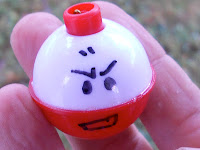
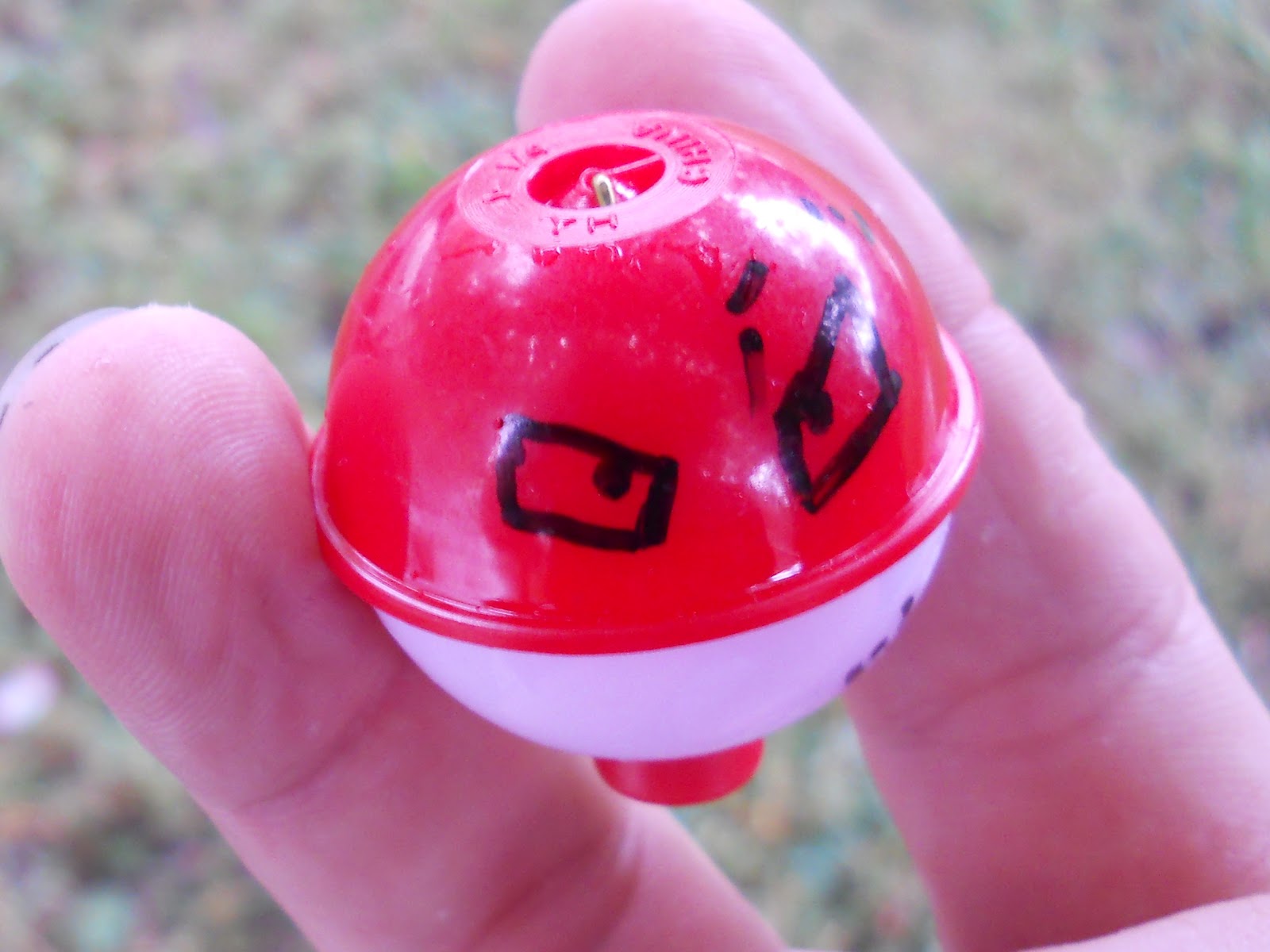
Now, you need to be able to present your bait at the proper depth.  This is where sinkers and floats (or bobbers) come in.  Sinkers are usually made of lead.  Lead is cheap, heavy, soft and easily molded, and terrible for the environment.  If you are trying to be environmentally friendly, there are lead alternatives.  Tungsten, steel, or tin are used to make lead free sinkers.  Tungsten and steel are heavy, but too hard to mold, so they usually come in shapes that would be tied onto your line.  Tin is softer, but not as heavy.  Since it is softer, it is available in split shot.  Split shot is clamped onto your line easily with a pair of pliers.  (Don’t use your teeth, especially with lead split shot.)  If you are just going to fish on the bottom for big bottomfeeders, the sinkers will get you where you are going.  However, if you are fishing for sunfish, bluegill, largemouth bass, and other fish along those lines, you might need to present your bait suspended between the surface and the bottom, because that is where most fish live.  Putting a float on your line anywhere from ten inches to about six feet up from the hook, with a couple of split shot  somewhere in between (make sure your float is buoyant enough to float with your weight) will suspend your bait at a good average depth.  Floats come in all sorts of designs, but the most common kinds are either long balsa floats, or plastic spheres that look just like Poké Balls from Pokémon.  The video game nerd in me loves the Poké Ball floats.  I can draw little faces on them and make them look like Voltorb and Electrode, or just pretend i’m throwing out a Poké Ball to catch a Magikarp.  Gotta catch ‘em all!  Really I see no advantage over one type of float or another.  If anyone has an opinion over what type of float is better for any occasion over another, please share.  
hand drawn face on a red and white bobber
My Voltorb float
hand drawn electrode face on a red and white bobber
My Electrode float
Finally, bait.  Probably the simplest option would be to use earthworms.  In my hometown of Muskegon, Michigan you could buy worms and many other kinds of live bait at any gas station.  In Milwaukee, live bait is much harder to find in stores, but who needs to buy live bait?  Plan ahead, save a glass jar and put some nice moist black soil in it, then wait for a soaking rain.  When the rain has cleared, get out there and start collecting your bait from the sidewalk before the birds get it all!  Alternately, if there is a wooded area near you, you can turn over stumps and logs.  You have to be quick, earthworms are pretty photophobic and will dart into the soil faster than you thought possible.  Many nightcrawlers can be found under logs; a nightcrawler is a very large earthworm used for fishing.  There are almost endless possibilities for live bait.  You can use minnows, crickets, maggots, mayflies and their larvae, leeches, frogs and so many others.  According to my dad, my great-grandfather used to fish for musky with live squirrels, i’m not sure if that’s even legal!  I have also heard of kittens being used as shark bait.  I am strongly against this.  Personally, the most advanced life form I think that should be used for bait is live fish.  Anything more advanced than fish just seems to be cruel, you have to draw a line somewhere.
earthworm and nightcrawler

Once you have acquired all of these things, you are pretty much ready to start fishing!  There is actually one more crucially important thing, you need a fishing license, well, at least in the USA you do.  Prices, as well as laws vary from state to state, so read your state’s guidebook.  If you get caught fishing without a license YOU WILL REGRET IT! 

Fishing with live bait can be a lot of fun, but there might come a time when you want to switch to artificial bait.  Artificial bait and lures will be discussed at a later point.  Now, go catch some fish!