Showing posts with label ITEM. Show all posts

Monday, December 10, 2012

Tying Flies When You're Having Fun

Makeshift mancave
Catching fish on your own flies is a lot more rewarding than catching them on flies you bought.  Fly tying can be as simple or as complicated as you want to make it.  I started with a Gander Mountain fly tying starter kit that included a tying vise and other tools, hooks, some materials, and a handbook; it cost about $50.00.  I still use all of the same equipment, although I hope to upgrade someday.  In this post, I'm going to talk about the essential tools and materials for tying a few flies that I have found to be particularly successful.

The tools I use for almost every fly are listed below.
  • Tying vise
  • Bobbin
  • Scissors
  • Hackle pliers
  • Bodkin
assorted fly tying tools and hooks

The vise, bobbin and scissors are the most essential.  Hackle pliers are really helpful for holding tiny hackle feathers for dry flies, or even just holding larger feathers out of the way while working other materials in.  In a pinch, you could probably get by with forceps or a clothespin.  The bodkin is used for many things, but you could probably improvise with a safety pin or a sewing needle.  Of course you'll need a mug of coffee, and some music too.  I find myself listening to a lot of Primus when tying flies, but really, anything southern or kind of twangy or nautical themed makes for good fly tying music.  Mastodon's Leviathan album is a good one if you like a little heavier music; it's a concept album based on the novel Moby Dick.

Of course you are going to need some hooks, and some materials for tying.  The following is a list of the materials I use most.
  • Thread
  • Chenille
  • Hackle feathers
  • Marabou feathers
  • Dubbing
  • Copper wire
  • Beads
  • Flashabou
I probably don't need to tell you that you will use thread on every fly you tie--but I will.  I use black the most, but I make sure to always have red, olive, and tan on hand.  Some people have a bobbin for each spool of thread, but I just use one.  Copper wire is used to add a segmented look to the bodies of some flies, or just to add flash and color.

assorted spools
Fly tying thread and wire

Chenille is a soft yarn used to make bodies of flies.  I use it a lot, because I tie a lot of Woolly Buggers.  I always have black, olive and red in my ITEM list.  Woolly Buggers are great flies for trout, bass, and many other kinds of fish.  If you only ever learn to tie one fly, it should be the Woolly Bugger.

black olive, and red
Assorted fly tying chenille

Different grades of hackle are used for different flies.  Neck hackle is used mostly in tying dry flies; the short, stiff bristles make the fly float on the surface and mimic insect legs in the water.  Saddle hackle is usually not considered high enough quality for tying dry flies, so it is usually used in streamers to make the fly appear to be swimming or pulsating in the water.  Soft hackle is used in a lot of wet flies.  I use saddle hackle mostly, because it is used in Woolly Buggers.  I haven't tied a lot of dry flies.

A neck of red hackle in the center,
Black and grizzly saddle hackle on either side
Marabou feathers are very soft feathers that absorb water rather quickly.  They add a lot of very natural appearing movement in the current.  They are used in the tails of Woolly Buggers and some other streamers.  I make sure to have black and olive marabou in my collection for tying Woolly Buggers in those colors.

Black and green marabou
Marabou is very soft
Dubbing is used in a lot of flies.  there are going to be nymphs, dries, streamers, and wet flies that all call for dubbing.  Dubbing is fur from soft furred animals that is wound around the tying thread and used to build up the body of the fly.  In early fly tying, most salmon flies called for seal fur-- good luck finding that!  Dubbing today is made from the fur of animals like opossums, beavers and rabbits-- I've been tempted to try using hair from my cat, but haven't yet.  I use dubbing most often in tying scuds.  Scuds are tiny freshwater shrimp that fish regularly feed on.  Scuds are fairly simple to tie, require only a few materials, and very effective for trout and bass when dead drifted.

olive, grey, and tan
Olive, grey, and tan dubbing
Beads are used as the heads of nymphs and streamers.  They add a little bit of weight to sink the fly faster, and add flash and color.  I'm not sure, but I think the idea of using beads is a fairly new innovation to fly tying.  In earlier times, (and even still) some streamers called for lead wire to be wrapped around the hook shank.  My fly tying kit even came with some lead wire for use in Woolly Buggers.  But with the added flash and color of bead heads, there is no need for anglers to be further polluting our streams by adding lead to the ecosystem.  Not only are beads safer for the environment, they also seem to improve the effectiveness of most flies when used in appropriate sizes.  I keep several shapes, sizes and colors.  Use heavier beads on big Woolly Buggers in swift currents and deep pools, smaller beads can be used on tiny nymphs and scuds dead drifted in slower water.

and assortment of beads and flashabou
Assorted bead heads and flashabou
Flashabou is a synthetic material that has a prismatic or iridescent pearly reflective quality. A few strands of flashabou in the tail of a Woolly Bugger may help attract fish to your fly.  It doesn't take a lot, I've had the package pictured above for about three years and I've hardly used any!  A package of flashabou is a good investment.

I have some other materials that are used in particular flies that I don't tie so often, but it's nice to have them if you need them.  Pheasant tail feathers are used in tying Pheasant Tail Nymphs and Copper Johns.  Pheasant Tail Nymphs are highly effective, but they are not easy to tie, at least for me.  They're tiny, and they test my patience-- but a Pheasant Tail was the first fly I tied that I caught a trout on!  Peacock Herl is used in a lot of flies, and fish love it.  Anything with peacock herl in it  is going to be an effective fly.  You can tie peacock herl on a hook by itself and it will catch fish.  Common flies that call for peacock herl are the Royal Coachman, Pheasant Tail Nymphs, and Prince Nymphs.  I have some goose biots because Prince Nymphs call for two white goose biots.  However, the goose biots I have are from Canada geese.  I found them in the park, so I'll improvise.  Finally, I have some elk hair.  Elk hair is used in a legendary dry fly, the Elk Hair Caddis.  When you want to catch fish on a dry fly, the Elk Hair Caddis is probably what you would tie on first if there isn't any kind of hatch to match.  The Elk Hair Caddis is quite tricky to tie.  I haven't quite gotten the hang of it yet.  The hair is very stiff and it's hard to get used to working with it.  There are other flies that use elk hair as well, like the Muddler Minnow.  I tried tying a Muddler Minnow.  It didn't turn out great, and I never caught a fish with it.

Various feathers, elk hair for fly tying
From left to right: Pheasant tail, goose biot,
peacock herl, and elk hair
It's also helpful to have some sort of a book to explain how to tie flies.  The Milwaukee Public Library has a pretty good selection of fly fishing and fly tying books at the central location.  I recently checked out a book titled Salmon Flies: Their Character, Style and Dressing by Poul Jorgensen.  The book is beautiful with some of the most intricate flies I have ever seen, but it requires complicated techniques and materials from exotic animals.  There is a chapter called "Simple Strip-Wing Flies" that explains how to tie the Blue Charm in 43 steps, using 11 materials!  I think there was a fly in the book that called for moogle dubbing, Cockatrice pinion, Chocobo hackle and Phoenix Down!  The book is so complicated that to a fly tyer of my skill level, it reads like a work of fiction.  Most flies are far simpler.  My kit came with a handbook that gave instructions on how to tie flies that will catch fish using just two or three materials.

2 books
The extremes of fly tying
If you're looking to get into tying, the materials that you will probably get the most use out of are chenille, some hackle, dubbing and marabou.  With just those few materials, you can tie a few very successful flies.  You can get them at any Gander Mountain or Cabela's.  If you live in the Milwaukee area, you can get great materials, good advice, and even take a tying class at The Fly Fishers.  In my next post, I'll demonstrate some basic fly tying techniques, and give instructions on how to tie an effective fly using only two materials.

Friday, October 5, 2012

I Don't Know How Much Longer I Can Hold This

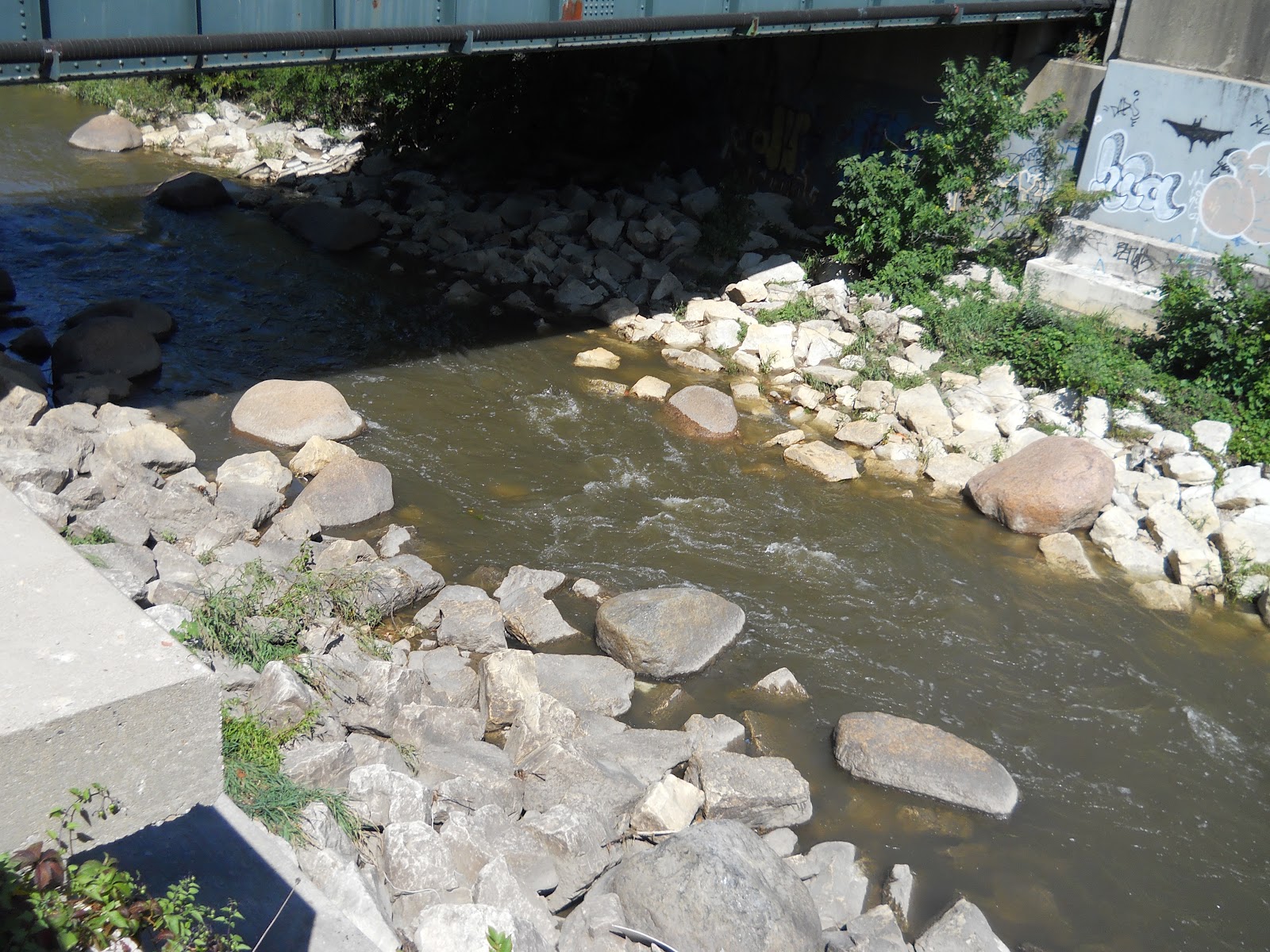
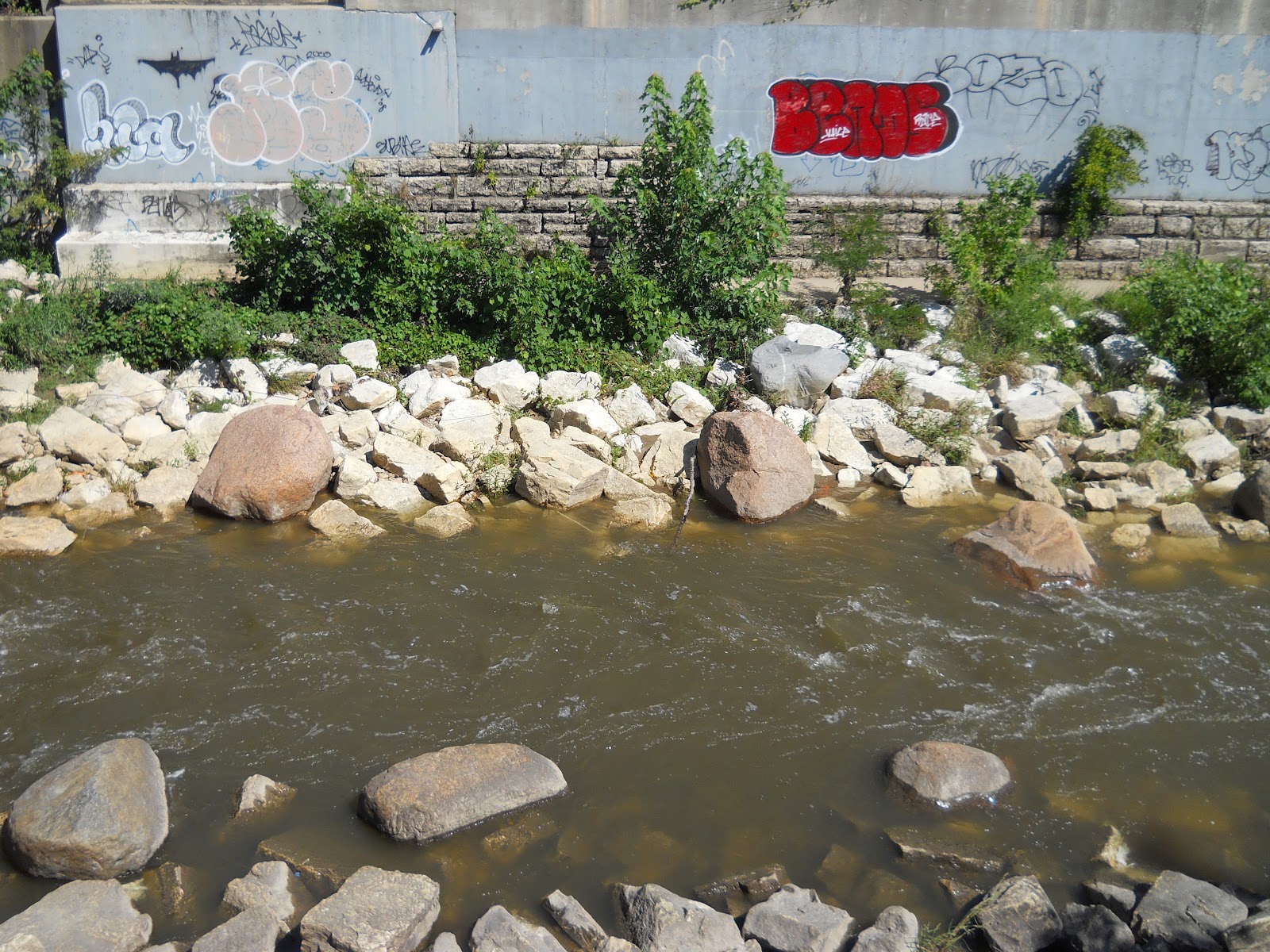
All this time we've lived in our new apartment, I would always go upstream to fish the more natural stretches of the Menomonee River.  Keep in mind, "more natural" is a relative term, meaning, much less concrete and spray paint.

I had errands to run, which brought me near a park along the Menomonee about two miles farther downstream from where I usually fish.  I parked my car, got my gear,  jumped the wall, and saw fish everywhere.  Suckers, salmon and pike all over among the piles of "evidence" of so many unsolved, possibly unreported crimes.  Fish finding cover amongst skateboards, refrigerators, a stop sign, construction barrels, bicycles, chef's knives, chef's knives?  CHEF'S KNIVES!  I start casting, but it's a tough crowd.  The pike are amongst the suckers, why would they chase a swimbait?  I walked a ways up and down stream, amazed by the size of the fish I saw, but time was short, and after this, I knew where to find fish.  This kind of water is all new to me!  It reminds me of the motorcycle chase scene from Terminator 2.  The lower urban stretch is still within walking distance, I've always just been walking the wrong way, a return trip would be necessary.


A pair of northern pike.

Click to enlarge.
The weekend found me in the concrete canyon of the lower stretch of the Menomonee River an awful lot.  I had never seen another person down there, but apparently the word is out that the autumn salmon run has begun, despite the catastrophically low water levels.  Instinct can overcome low water, log jams, even miles of concrete and mounds of forensic evidence.  I wasn't ready to fish, I was just there to observe, as were many others.  I only saw one guy catch a fish, a beautiful female.  Saturday evening while walking with my baby in the carrier, we found a sweet fossil.  Weekends are always crazy for salmon fishing, I waited to wet my line until monday.

This guy caught her on a spawn sack.

Pretty awesome trilobite fossil.

Catching a salmon on a fly was something I've always wanted to do, so I tied some egg sucking leeches over the weekend.  I waited until mid morning to hit the stream with my gear, there were salmon everywhere -- and I had the stream to myself.  It wasn't long before I was hooked up with a big female.  She was tired, but still had some spirit!  I landed her and released her above the rapids she was struggling to get over.  A male followed, also released above the rapids.  The third fish fought the hardest; a nice male that ran downstream, forcing me into a thousand yard chase; the concrete bank makes for a great sidewalk.  The fish eventually tired and came in.

One of my hand tied #6 egg sucking leeches.

Fish on!

Nice female

Not as pretty as the female.

Action shot, I was just along for the
ride with this guy.

I love the color of
a spawning male

Resusitating the fish.

Such a beautiful sight, seeing
him swim away,

Three fish landed on the fly, three fish released.  What a great way to start the week.  I followed it up by catching and releasing three more Tuesday on spinning tackle with my baby girl, landing two of them by hand.  All of them were caught on Thundersticks.  One had a gold Little Cleo stuck in its tail that I took out.  Wednesday, I caught and kept a 34" female.  Seven fish in three days, those accomplishments are coming along pretty nicely.

34" salmon 

Achievements unlocked
  1. (*) Gold Hook (Catch a game fish over the minimum length requirement)
  2. (*) Baby Bear (Catch a member of the family: Salmonidae)
  3. (*) Mama Bear (Catch a member of the family: Salmonidae that measures over 30")
ITEM Pickups
  1. GOLDEN LITTLE CLEO
  2. TRILOBITE FOSSIL

Friday, September 7, 2012

Leveling Up

The first thing I like to do when my family moves into a new area is find the closest body of water and come up with a list of achievements to "unlock" on said body of water; like playing video games.  Looking for special "ITEMS" to add to your "Inventory" is also fun.  There are two bodies of water within walking distance of our current apartment, the Menomonee River, and the Washington Park Pond.  My achievements to unlock and ITEM pickups are listed below, I'll list the conditions that need to be met to unlock these achievements as I complete them.

Menomonee River
Achievements
  1. (*) Blue Heron (locate three areas likely to hold fish)
  2. (*) Eagle Eye (visually locate fish)
  3. (*) Bronze Hook (catch a fish)
  4. (*) Silver Hook (catch a game fish)
  5. (*) Gold Hook (Catch a game fish over the minimum length requirement [Achievement unlocked 10-1-2012]) 
  6. (*) Cleanup Crew (catch a rough fish)
  7. (*) LATFH (catch a fish on the fly)
  8. (*) Elitist (Catch a fish on a dry fly [Achievement unlocked 09-02-13])
  9. (*) Baby Bear (Catch a member of the family: Salmonidae [Achievement unlocked 10-1-2012])
  10. (*) Mama Bear (Catch a member of the family: Salmonidae that measures over 30" [Achievement unlocked 10-3-2012])
  11. ( ) Papa Bear
  12. ( ) Hungry Bear
ITEM Pickups
  1. FOSSIL FRAGMENT
  2. FOSSILIZED CORAL
  3. DISK GOLF DRIVER
  4. GOLF BALLS

The stretch of the Menomonee River that I live by is very urban, right on the edge of the Menomonee Valley.  People might ask, "Why are you gonna fish in there?"  Because it's there!  It apparently has decent salmon and steelhead runs, and in the past it was stocked with rainbow trout, bass, and pike.  It's too tempting not to fish, and it's a fun place to hang out.

Very urban.

The Menomonee is kind of tucked away and
out of view to most.

My brother Shane throws a golf ball.

After a little rain, it muddies right up.

Looks like dirty dishwater.

As you go upstream, it becomes more natural looking.

So pretty in this stretch.

It doesn't seem to take long to clear up after the rain.

Beautiful remnants of an old bridge

Nice undercut bank.

I found these beautiful flowers.

So pretty, I couldn't bear to pick
one for my wife and daughter.

Some kind of shiner.

Bluegill on a beadhead scud.

FOSSIL FRAGMENT.

FOSSILIZED CORAL.


Washington Park Pond
Achievements
  1. ( ) Garden Hackle
  2. ( ) The Conqueror Worm
  3. ( ) It's Super Effective!
  4. ( ) For Beginners 
  5. ( ) Pond Scum
  6. ( ) Matador
  7. ( ) Pot O' Gold
  8. ( ) Pond Lord
Washington Park Pond is stocked with some gamefish and catchable trout.  The urban ponds have some different regulations, they're posted around the pond on big yellow signs.  I've never fished it, but I have noticed a lot of surface action in the evening when walking around the pond.  It gets pretty crowded at certain times, but now that kids are back in school, a mid-week fishing stroll might be in order.  When I finally do get a chance to fish the pond I'll post some pictures.

Coming up with lists of achievements is a fun way to fish.  It gives you a goal, something you can check your progress against.  Each time you unlock an achievement, you'll level up for that body of water!  I know it's super nerdy, but I'm a pretty nerdy guy.  My wife calls it "Karping," like Larping-- get it?