Showing posts with label artificial bait. Show all posts

Thursday, August 29, 2013

Repost: Fishing For Big Trout And Salmon in The Great Lakes

The salmon run is fast approaching, and this old blog post of mine has been getting a lot of traffic.  I'm doing something I've never done and recycling some old material to help my followers get ready for the salmon and steelhead run. 

First off, I've added a couple new pages, a little bio about myself, and a page with links to the official fishing websites for every state, and Canadian province.  This could be helpful if you're ever planning a multi state or international fishing trip.

A couple enjoys the view on Milwaukee's
north pier
Fishing for salmon and big trout is one of the reasons I love living so close to Lake Michigan.  If you've never seen one of the Great Lakes, they're big!  My Minnesotan wife still calls Lake Michigan "the ocean."  As I discussed in an earlier post, most trout and salmon aren't native here, so the Great Lakes might be a nice opportunity to get out on a stream and catch a nice chinook without going to Alaska.  Fishing out in the lake with a boat is the obvious way to go, but I don't have a boat, and I'm going to assume you don't either.


Mckinley Marina in Milwaukee
What you are going to want to do is find a pier, or some structure that allows you to get out in the lake.  I think the wall provides cover for smaller baitfish, and big fish come there to be treated to a buffet.  When fishing off the pier or even just off a wall into the bay in Milwaukee, I like to use big, heavy spoons that cast far and get down deep.  In my opinion, Acme Tackle makes the best spoons, with my favorites being the Little Cleo, The K.O. Wobbler, and the Kastmaster.  I've caught more salmon on Little Cleos than on anything else, I even mentioned the name Cleo for my daughter, but the wife shot that idea down.  I like the silver and blue ones for salmon.  I've never caught a steelhead, but I hear that orange is the hot steelhead color, and gold is good for big browns.  When fishing the lake, I'll use a heavier one, the 3/4 oz size casts further and sinks faster.  The Kastmaster also casts very far, it's not just a clever name.  With these lures, just cast as far as you can and wait while the lure sinks.  Retrieve the lure just fast enough to make it wobble, you'll feel it.  You can also use Wildeye Swimbaits or Rat-l-traps for trout and salmon in the lake.  There is no telling what else might bite those though.  Fishing in the lake is great fun, the bites might be few and far between, but there's something about sitting along our gorgeous glacial sea all day with a sandwich for lunch, and a beer or three that takes you far away from the world while a million people scramble in the city just a half a mile away, completely oblivious to what a beautiful resource we have.

I found this Kastmaster in some streamside bushes

little cleo, gold and red.
The Little Cleo is about the sexiest lure there is

beat up looking rat-l-trap
My Rat-l-trap has seen some action!

In about mid August, the salmon will start to move toward their natal stream. This time is the best opportunity to catch them in the lake, or even in the channel if they start to swim upstream.  Any change in the weather will make them start to move and then you can try to catch them in the streams.  It might just take a drop in temperature, or a little rain and a few overcast days to make them start running.  I've caught salmon in the middle of August in the White River in Michigan, but this year, I didn't see any salmon in the Menomonee until the end of September.  In the streams, I'll still use Little Cleos in deeper pools, but I may use a 2/3 or 2/5 oz instead of a heavier one.  They move a little more erratically in the current than a heavier one.  I will also use some diving crankbaits in the streams; Storm makes my favorites, and they're reasonably priced too.  The deep diving Thunderstick Jr. and the Hot 'N Tot are the ones I use most.  You will find that fishing in the stream can be very frustrating.  There are days when the salmon are so thick that you could walk across them, but they won't bite a thing, then other days, they'll bite anything!  If you're on the stream and salmon are flying out of the water like ballistic missiles from a Russian nuclear submarine, that is the day they will bite anything.  You will probably get splashed by salmon jumping, and they'll scare the hell out of you, but they are angry at everything in the water.  All you have to do is put something in the water with some hooks in it.  The best days always seem to be overcast and rainy days.  I've had the best luck in the evening on overcast and rainy days; not a really hard downpour, just a steady rain.  In both the stream and the lake, using ten pound test line is probably adequate.  I've seen guys use 20, but that's overkill.  This season, I used 6 pound test and I only had one salmon break my line.

three storm lures
Two Hot 'N Tots and a Wiggle Wart

My Thunderstick, marred by salmon teeth.  Note the
scale just behind the front hook.

This is the first year I've ever spent a lot of time fly fishing for salmon.  I cut the tapered leader down to about three feet and just tied on about six feet of hybrid six pound test.  I used mostly Woolly Buggers, and egg sucking leeches.  I haven't had a chance to use my creation, the Force Choking Leech, very much.  You can find instructions on how to tie it here.  If you're a fly fisherman, you're probably better at it than I am, so I can provide very little instruction.

black and red egg sucking leech
Egg sucking leech with flashabou in the tail

black cat sniffs a streamer in the tying vise
Kittie examines my fly tying skills

black woolly bugger, silver cone head.
Probably the best looking bead head Woolly Bugger
I ever tied.
Salmon and trout can be hard to catch, but you'll remember your first one forever!  I fished for salmon for a few years before I caught my first one, It was October 1, 2002.  It takes time to learn how these fish work.  I can feel the change in the weather that brings the salmon into the streams now,  an instinct I can't explain.  The clouds look a certain way, the air has something different about it.  It took me years of fishing and lots of luck before I even had a salmon bite.  How bad do you want it?

Monday, July 22, 2013

A Great Day On The Milwaukee

We got around a half inch of rain last night.  That paired with the change in the weather had dramatic effects of the Milwaukee River smallmouth bass population.  I took my little girl out again this morning so my wife could get some more sleep, and I had one of the greatest days I've had on the Milwaukee.

Here is my highlight reel from the day


Little Cleo loves to pet them
 

These next three fish were caught on three
consecutive casts!


Probably my nicest fish.


This Mr twister took a royal beating!


What a great way to start the day!

Friday, November 9, 2012

Never Underestimate The Power of The Dark Side

Egg sucking leeches are great flies.  They are just a variation on a Woolly Bugger, which is arguably the most effective streamer of all time.  There is, however, one variation that drives me crazy, and that is the bead head egg sucking leech.  Whether it happens or not, I can picture a leech creeping up through the river bed and latching onto a salmon egg; and I can picture how enticing this two course combo meal would be to a steelhead.  Like getting orange chicken and beef and broccoli at Panda Express!  But then if you throw a bead in there, I can't wrap my imagination around that.

I'm sure it works, but...

Enter my contribution to the fly tying world:  The Force Choking Leech!  I found some black cone head beads and got the idea to tie the egg onto the hook first with red thread, then whip finish it.  Then add a bead, but I put the bead on backwards.  


egg sucking leech

Next, I tie on black thread, tie in black marabou for the tail , black chenille and a black hackle feather for the body.


Wrap the chenille and the hackle forward towards the bead as you would a Woolly Bugger, and tie them off.  I wrap a lot of thread to build up a smooth taper onto the head, but I do that before tying in the extra stuff.


Whip finish the black thread just behind the bead and you're done.  Welcome to the Dark Side, now go choke some fish!

I came up with the name in that haze between sleep and consciousness, before the alarm goes off, but you know it's going to go off soon--  The black bead reminded me of Darth Vader's helmet.  From there, the "egg" is red, like Vader's lightsaber, and, the body is black, like the Sith Lord himself.

I haven't really tied a lot of these.  I'm going to experiment with some other bead colors, but I like the look of the all black and red.  Maybe olive with a gold bead and a black egg, who knows?

If you've never tied flies before, I'll discuss what is absolutely needed and what you can do without in a later post.  I also have a few flies that I will try to teach you to tie.  some are so easy, you probably won't even believe they catch fish.


Sunday, September 2, 2012

A New Hope

Eventually, there will be a time when you're out fishing and you just aren't catching anything!  It's really not that big of a deal, you know?  The worst day fishing is better than the best day at work, am I right?  Nonetheless, getting skunked is a bummer.  It's gonna happen from time to time, but you have a secret weapon, you have (or at least you should have) a rarely used Mepps spinner!  I like to keep at least two at all times, a shiny one, like silver or brass, and a brightly colored one, like Firetiger (orange/yellow/green).  The Aglia comes in sizes 0-5, and is the best known Mepps spinner, but there are other lesser known models that are super effective (like Charizard using Inferno on Paras) for some particular species.  The only setback to Mepps spinners is the price.  They usually run about $5.00 for a number five, and they get cheaper as they get smaller,  and assortments of five will cost over $20.00.  There's a reason they're this expensive, they work!  And really, that's a fairly average price for most lures.  Sometimes you'll find some off the wall color on sale, like my pink one pictured below.  Don't question the color, just buy it!

Lots of Mepps
A collection of Mepps lures.
My current Mepps Aglia stash.

Nice Lake Michigan brown trout, note
the lateral line in the glare.
(Click to enlarge)
In order to know what makes Mepps spinners so effective, you need to know a little about fish anatomy.  Fish have an additional sense to the five senses we have, actually, it's more of a hybrid sense combined of several senses from how I understand it.  The receptive organ for this "sixth sense" is the  lateral line, it can be seen easily on most fish once you realize it's there.  It runs from just behind the gills to the base of the tail.  This organ helps the fish with spatial awareness when traveling in schools or when tracking prey.  It detects electrical impulses caused by muscle movement of other fish, and it detects vibrations caused by water being displaced, almost as if a fish could "feel" outside of its own body, and "feel" sound.  The Mepps spinner blade spins rapidly as the lure is retrieved, causing a lot of vibration and displacement in the water.  So you got the vibration stimulating the lateral line, and then the blade will flash very brightly, triggering a visual reaction, And I'm sure there is all kinds of noise coming from the blade as well.  The triggering of these senses almost seems to initiate a striking instinct.  Even fish that aren't feeding may chase down and attack a spinner.  Some people say that the blade doesn't have to be spinning to initiate a strike, and I'm sure that's true-- but it's like using a fully loaded Desert Eagle to melee someone to death, why wouldn't you just shoot them? Here's a brief story about a time I witnessed a pike chasing my lure.
One time, I was retrieving a spinner off the breakwater in Lake Michigan in Milwaukee, and as it became shallow enough to see, I spotted a pike giving chase!  The lure was almost reeled all the way in, so I slowed my retrieval to allow the pike to catch up.  As it slowed, the blade stopped spinning, the lure started to sink, and the pike stopped dead in the water, six inches from the lure.  I decided to really rip it hard, get that blade cranking as hard as it could, The pike lunged like a lightning bolt and grabbed the lure like it couldn't control itself, the spinning of the blade drove the pike into a frenzy!
 In  a trout stream, choose a small Aglia, a 2 or smaller.  In slower currents, cast upstream and reel back fast enough to spin the blade, you will feel the blade start spinning.  Reel it over submerged boulders and other cover.  You can cast across the current ahead of a pool and let it drift through, the current will make the blade spin as it swings through the pool.  You can use these same techniques in smallmouth streams, but you might want to use a bigger size.  I usually use a size 3 for smallmouth.

An assortment of Aglias
In inland lakes, choose a size 4 or 5 for largemouth bass and pike.  Mepps makes a huge spinner (sizes 6-7) for musky, called the Musky Killer.  It looks like a squirrel hanging from a remote controlled helicopter!  I just stick to the standard sizes.  If you're fishing for panfish, a size three or smaller should do the trick.  My step-grandpa was an avid fisherman, and he loved the Mepps Comet Mino for Pentwater Lake smallmouth bass.

A Musky Killer, measuring
5.5 inches long!

Mepps Comet Mino.
(R.I.P. Grandpa Joe)
In Lake Michigan, and the channels, a size 5 might work for salmon when nothing else will. My dad loves to tell a story of a time he was fishing for salmon off the south pier of the Muskegon Lake Channel during the early 80's.  During the salmon run, guys will fish shoulder to shoulder on the pier.  My dad found a spot on the rocks and saw that everyone was casting spoons with no success.  He tied on a number 5 Aglia and limited out in like a half hour!  He said guys were offering him hand fulls of cash for his Mepps as he walked back with a cooler full of big salmon; to this day, I don't think he goes out without at least one.  I'll even cast a size 5 along the channel rocks, big rock bass will strike a number five.  There was this one partly cloudy day that I was fishing the rocks and just killing the rock bass with a brass number 5.  The sun disappeared behind the clouds, and they just stopped biting.  So what I did then was tie on a size 5 Firetiger and killed 'em again, until the sun came out.  That's why I keep a shiny one and a brightly colored one.  The shiny ones seem better in the sun, the bright colors work under clouds.  So all that day I kept switching colors, depending on the conditions.  I kept eight rock bass between six and nine inches that day and threw at least that many smaller ones back.

So, next time you're out fishing and just not catching anything, open up your tackle box, reach for your brand new unopened size 1 Aglia and say "help me number one, you're our only hope," and start fishing in an epic way!

Thursday, August 30, 2012

Keep Calm And Carry Wildeye Swim Baits


I’m positive that you will enhance your fishing experience once you’ve gotten the hang of fishing with curly tail grubs.  When you fish with live bait, the bait does the fishing, but when you fish artificials, you do the do the fishing by making the lure resemble something they want to eat; you have to know how the fish think.  The next fishing lure every angler needs in their tackle box uses the slogan, “Think Like A Fish,” it’s the Storm Wildeye Swimbait.  They are soft plastic bodies molded around an internal weight.  There are some pros and cons to these lures, let’s just get the cons out of the way and then we will be free to discuss how truly awesome these things are.

My current Wildeye collection.  Note the sunfish
on the right with the missing tail.

Most Wildeye Swimbaits have a single dorsal (back) hook and a ventral (belly) treble hook.  The treble hook tends to get snagged a lot.  When fishing in areas with a lot of snags, you can take the treble hook off; it’s only attached with a split ring.  The lure isn’t quite as effective without the treble hook, but it’s better to lose fish than to lose lures.  Also, a big fish tends to wreck these lures in a fight.  The soft portion may be torn from the solid center, the tail may be bitten off, or the lead weight may be knocked loose from the dorsal hook.  Honestly, any fish you can catch that’s big enough to wreck a lure is something to be proud of.  Release the fish, and keep the lure as a trophy.  And the final issue has to do with quality control.  Sometimes you will get a lure that won’t swim straight, or the tail won’t move during the retrieval.  I’m not sure if it’s the packaging or the production.

Ventral hook removed.

Despite these setbacks, Wildeyes are amazing lures!  They are usually sold in packs of three, and usually cost around $5.00.  They are shaped and painted in many different body styles to resemble a wide variety of small fish that big fish eat, so these things attract just about any kind of fish that may occasionally eat smaller fish, and they are pretty easy to use, just cast out and reel in.  The tail paddles on the retrieve making it look like a swimming bait fish, hence the name swimbait.  You don’t have to work too hard to impart action into the lure, since the tail does it for you.  The final reason you should have Wildeye Swimbaits in your tackle box is because of the size of the fish they catch.  I am consistently shocked by the monsterous fish caught on these!  The smallest fish caught with these was a 10” musky while bass fishing; to this day, it was the only musky i’ve ever caught.  Here’s my list of fish caught on Wildeye Swimbaits.
  • carp
  • chinook salmon
  • freshwater drum (sheephead)
  • largemouth bass
  • muskellunge
  • northern pike
  • rock bass
  • smallmouth bass
  • splake (brook trout X lake trout hybrid)

Suspending Wildeye
Swim Shad.
In streams for smallmouth bass, I like to use a suspending Swim Shad much like I’d use a Mister Twister.  Cast upstream ahead of pools, or along cover likely to hold fish.  The suspending Swim Shad sinks ever so slowly as the current carries it through the pool and into the mouths of hungry fish.  When I “Think Like A Fish,” I imagine the bass think it’s a dazed minnow, and they can’t pass it up!

In the Great Lakes region, when the salmon are running up the streams in late summer, I like to cast a weighted walleye Wildeye (walleye Wildeye, walleye Wildeye, walleye Wildeye) into deep holes just before dusk.  The eyes of the walleye pattern glow in the dark, and this drives the salmon crazy, and they will strike out of anger!  A lot of times there will be deep holes under overpasses that hold big chinook.  If you’re ever driving over a bridge in the fall and notice cars parked all along it, chances are pretty good that the salmon are running.

West Michigan's White River under the countyline bridge.


White River from the bridge.


This beautiful chinook took a Wildeye walleye.

My cute little wife talks to seagulls
along the inner Muskegon Channel pier.
Another place I love Wildeye Swimbaits is deep channels and harbors.  Use a sunfish pattern; you can cast them along the rocks of the breakwater and reel them back in to try to lure out largemouth or pike.  You’ll want to retrieve right away when the lure hits the water to avoid getting hung up on rocks and driftwood.  Fishing along the rocks is fun and effective, but what I usually do in the channels and harbors is cast out as far as I can and let it sink to the bottom.  Reel back just fast enough to make the tail move, give some little rod tip twitches, and HOLD ON!  You’ll never know what you’re going to catch, but you’ll definitely know when a fish is on.  I caught so many big sheephead out of the Muskegon Lake Channel on these.  I know sheephead are not the most sought after fish, even considered “rough fish” (more on rough fish in a later update) but they are among the strongest fish I have ever caught!  The long casting technique was how I was fishing when I caught a 24” splake. Such a beautiful fish, and I didn’t have a camera with me.

In Great Lakes marinas, like Milwaukee’s McKinley Marina there are usually some nice fish, like bass, brown trout, carp, pike, walleye, and in the fall, salmon, but lots of snags.  If you get hung up, make a mental note of it.  You don’t want to lose your lure on a picnic table that someone used for ice fishing that didn’t get removed before the thaw, but it probably provides cover for a really nice bass, be careful!  Fish love the shade provided by docks, and the shoreline has some nice rocks for cover.  “Think Like A Fish” and have fun, I bet you can figure it out!

even carp will strike these! notice the sunfish
Wildeye in his mouth.

same fish, Mckinley Marina, 2010

There is one more lure that everyone needs in their tackle box that I will talk about in my next post.  It’s sort of a last resort, when you don’t know what the fish will strike, you’ll be glad to have this Jedi Master of a lure in your arsenal.  Hope the suspense doesn’t kill you!

Thursday, August 23, 2012

Keeping it Real With Artificials


Have you ever seen the film A River Runs Through It?  If you have, you must surely remember how the main characters looked down on bait fishing.  Don't worry, most people won't look down on you.  If you're happy catching your limit of bluegill on worms, then more power to ya!

Live bait can be extremely effective, and if you are just desperate to catch something, a worm on a hook under a Poké Ball float is the way to go.  But even the most hardened bait fisherman is bound to have some artificials in his tackle box.

Seriously?!?
There are many reasons to fish with artificial lures, they can be used to target specific species of fish, generally attract larger fish, and require you to be more involved because you need to make the lure appear to be alive and edible.  There are some places, usually trout streams, where fishing with live bait is actually illegal.

Lures come in so many forms that you can lose your head if you don’t know what you’re looking for.  The prices can range from under a dollar to upwards of ten or even twenty dollars!  However, there are some artificial lures that are super effective for many kinds of fish that are very reasonably priced.

For my next few posts I will discuss the three affordable lures that no fisherman should be without.  I will also share some techniques that I find particularly successful in specific situations.  

Thursday, August 9, 2012

Hook, Line and Sinker


As I mentioned before, just because you got a fishing rod, you are not quite ready to start reeling in the lunkers.    The easiest way to start is with live bait.  It requires the least gear, and you can catch a wide variety of fish, but you’re gonna need something to tie onto the end of your new line, as well as things to make your bait float... or sink.  

yo-zuri hybrid line
Let’s talk about line.  The line on that flea market rod might be older than you!  Ideally, your fishing line should be replaced every year.  The line starts to act a little crazy as it gets older.  It becomes much more likely to tangle, hard to cast accurately, knots won’t hold, and it becomes brittle and more likely to break.  Fishing line is usually sold with a rated breaking strength and the diameter on the package.  When choosing new line, choose the lightest line you are comfortable using.  If you plan on catching bluegill or perch or other panfish, you can probably do just fine with three pound test.  If fishing for big catfish, you might go with twenty pound test.  I personally never use anything above ten pound test.  There is a trade off. As your line gets heavier, you will have less strikes because the fish are more likely to see your line.  Heavier line is also harder to cast than light line.  There are so many different choices for line, and they are changing constantly.  There is monofilament, fluorocarbon, superbraid... maybe someday we’ll have nanotube line!  What I usually find myself buying is Yo-Zuri Hybrid, it’s a nylon monofilament and fluorocarbon hybrid.  I usually use six pound test for all around conditions.

assorted hooks
Click to enlarge
When it comes to hooks, I usually use Eagle Claw.  I’m not much of a bait fisherman, so i’m not in the loop of what the trends are for hooks.  A lot of red hooks have been noticed hanging in branches and telephone lines, and many reviews for “circle hooks” were read in magazines.  Truthfully, probably any average hook will work as long as it’s small enough to fit in the fish’s mouth.  If the hook is too big, the fish will repeatedly suck the bait from your line without taking the hook.

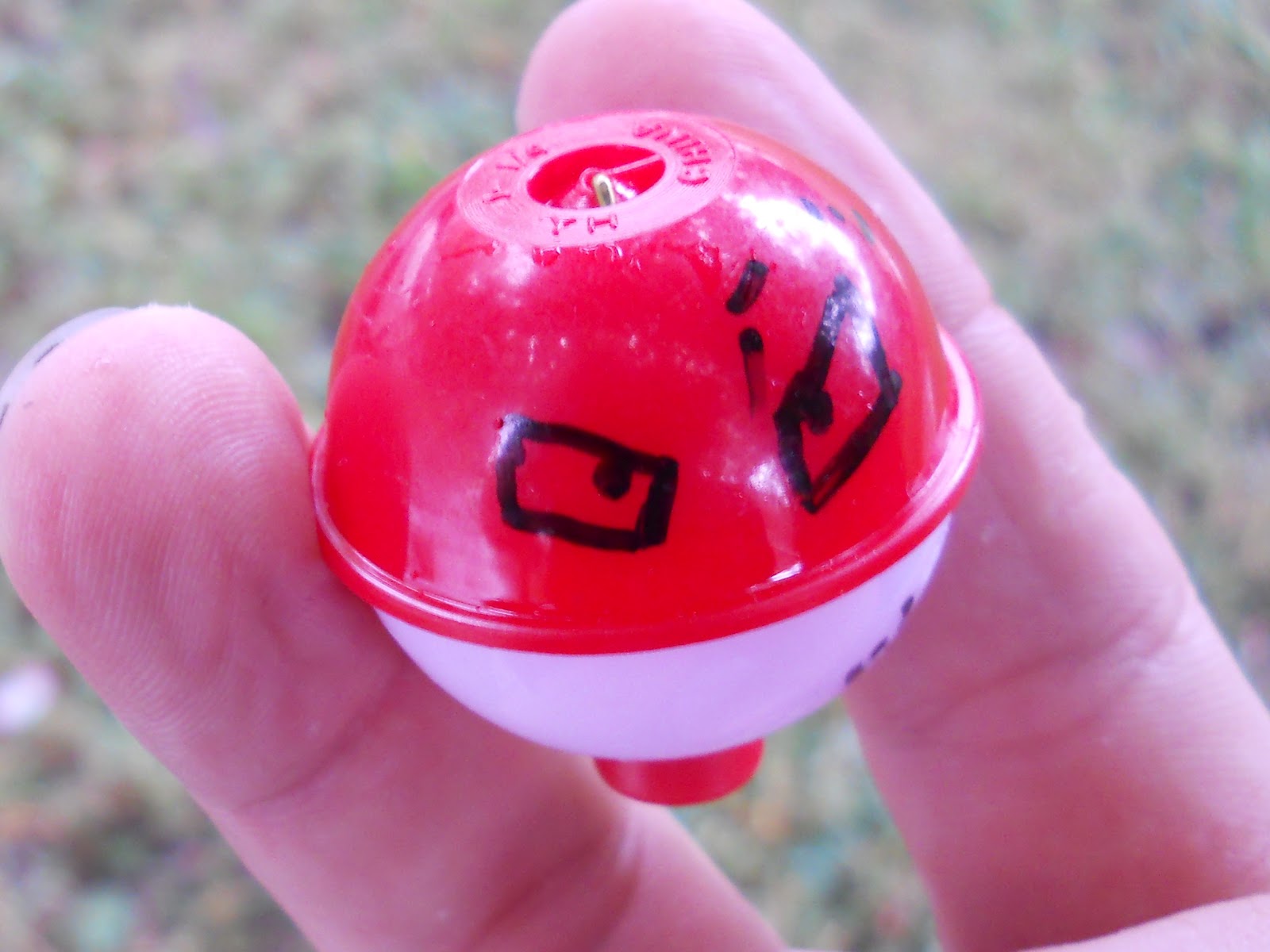
Now, you need to be able to present your bait at the proper depth.  This is where sinkers and floats (or bobbers) come in.  Sinkers are usually made of lead.  Lead is cheap, heavy, soft and easily molded, and terrible for the environment.  If you are trying to be environmentally friendly, there are lead alternatives.  Tungsten, steel, or tin are used to make lead free sinkers.  Tungsten and steel are heavy, but too hard to mold, so they usually come in shapes that would be tied onto your line.  Tin is softer, but not as heavy.  Since it is softer, it is available in split shot.  Split shot is clamped onto your line easily with a pair of pliers.  (Don’t use your teeth, especially with lead split shot.)  If you are just going to fish on the bottom for big bottomfeeders, the sinkers will get you where you are going.  However, if you are fishing for sunfish, bluegill, largemouth bass, and other fish along those lines, you might need to present your bait suspended between the surface and the bottom, because that is where most fish live.  Putting a float on your line anywhere from ten inches to about six feet up from the hook, with a couple of split shot  somewhere in between (make sure your float is buoyant enough to float with your weight) will suspend your bait at a good average depth.  Floats come in all sorts of designs, but the most common kinds are either long balsa floats, or plastic spheres that look just like Poké Balls from Pokémon.  The video game nerd in me loves the Poké Ball floats.  I can draw little faces on them and make them look like Voltorb and Electrode, or just pretend i’m throwing out a Poké Ball to catch a Magikarp.  Gotta catch ‘em all!  Really I see no advantage over one type of float or another.  If anyone has an opinion over what type of float is better for any occasion over another, please share.  
hand drawn face on a red and white bobber
My Voltorb float
hand drawn electrode face on a red and white bobber
My Electrode float
Finally, bait.  Probably the simplest option would be to use earthworms.  In my hometown of Muskegon, Michigan you could buy worms and many other kinds of live bait at any gas station.  In Milwaukee, live bait is much harder to find in stores, but who needs to buy live bait?  Plan ahead, save a glass jar and put some nice moist black soil in it, then wait for a soaking rain.  When the rain has cleared, get out there and start collecting your bait from the sidewalk before the birds get it all!  Alternately, if there is a wooded area near you, you can turn over stumps and logs.  You have to be quick, earthworms are pretty photophobic and will dart into the soil faster than you thought possible.  Many nightcrawlers can be found under logs; a nightcrawler is a very large earthworm used for fishing.  There are almost endless possibilities for live bait.  You can use minnows, crickets, maggots, mayflies and their larvae, leeches, frogs and so many others.  According to my dad, my great-grandfather used to fish for musky with live squirrels, i’m not sure if that’s even legal!  I have also heard of kittens being used as shark bait.  I am strongly against this.  Personally, the most advanced life form I think that should be used for bait is live fish.  Anything more advanced than fish just seems to be cruel, you have to draw a line somewhere.
earthworm and nightcrawler

Once you have acquired all of these things, you are pretty much ready to start fishing!  There is actually one more crucially important thing, you need a fishing license, well, at least in the USA you do.  Prices, as well as laws vary from state to state, so read your state’s guidebook.  If you get caught fishing without a license YOU WILL REGRET IT! 

Fishing with live bait can be a lot of fun, but there might come a time when you want to switch to artificial bait.  Artificial bait and lures will be discussed at a later point.  Now, go catch some fish!