Showing posts with label Great Lakes. Show all posts

Thursday, August 29, 2013

Repost: Fishing For Big Trout And Salmon in The Great Lakes

The salmon run is fast approaching, and this old blog post of mine has been getting a lot of traffic.  I'm doing something I've never done and recycling some old material to help my followers get ready for the salmon and steelhead run. 

First off, I've added a couple new pages, a little bio about myself, and a page with links to the official fishing websites for every state, and Canadian province.  This could be helpful if you're ever planning a multi state or international fishing trip.

A couple enjoys the view on Milwaukee's
north pier
Fishing for salmon and big trout is one of the reasons I love living so close to Lake Michigan.  If you've never seen one of the Great Lakes, they're big!  My Minnesotan wife still calls Lake Michigan "the ocean."  As I discussed in an earlier post, most trout and salmon aren't native here, so the Great Lakes might be a nice opportunity to get out on a stream and catch a nice chinook without going to Alaska.  Fishing out in the lake with a boat is the obvious way to go, but I don't have a boat, and I'm going to assume you don't either.


Mckinley Marina in Milwaukee
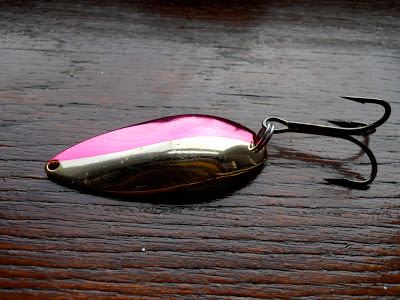
What you are going to want to do is find a pier, or some structure that allows you to get out in the lake.  I think the wall provides cover for smaller baitfish, and big fish come there to be treated to a buffet.  When fishing off the pier or even just off a wall into the bay in Milwaukee, I like to use big, heavy spoons that cast far and get down deep.  In my opinion, Acme Tackle makes the best spoons, with my favorites being the Little Cleo, The K.O. Wobbler, and the Kastmaster.  I've caught more salmon on Little Cleos than on anything else, I even mentioned the name Cleo for my daughter, but the wife shot that idea down.  I like the silver and blue ones for salmon.  I've never caught a steelhead, but I hear that orange is the hot steelhead color, and gold is good for big browns.  When fishing the lake, I'll use a heavier one, the 3/4 oz size casts further and sinks faster.  The Kastmaster also casts very far, it's not just a clever name.  With these lures, just cast as far as you can and wait while the lure sinks.  Retrieve the lure just fast enough to make it wobble, you'll feel it.  You can also use Wildeye Swimbaits or Rat-l-traps for trout and salmon in the lake.  There is no telling what else might bite those though.  Fishing in the lake is great fun, the bites might be few and far between, but there's something about sitting along our gorgeous glacial sea all day with a sandwich for lunch, and a beer or three that takes you far away from the world while a million people scramble in the city just a half a mile away, completely oblivious to what a beautiful resource we have.

I found this Kastmaster in some streamside bushes

little cleo, gold and red.
The Little Cleo is about the sexiest lure there is

beat up looking rat-l-trap
My Rat-l-trap has seen some action!

In about mid August, the salmon will start to move toward their natal stream. This time is the best opportunity to catch them in the lake, or even in the channel if they start to swim upstream.  Any change in the weather will make them start to move and then you can try to catch them in the streams.  It might just take a drop in temperature, or a little rain and a few overcast days to make them start running.  I've caught salmon in the middle of August in the White River in Michigan, but this year, I didn't see any salmon in the Menomonee until the end of September.  In the streams, I'll still use Little Cleos in deeper pools, but I may use a 2/3 or 2/5 oz instead of a heavier one.  They move a little more erratically in the current than a heavier one.  I will also use some diving crankbaits in the streams; Storm makes my favorites, and they're reasonably priced too.  The deep diving Thunderstick Jr. and the Hot 'N Tot are the ones I use most.  You will find that fishing in the stream can be very frustrating.  There are days when the salmon are so thick that you could walk across them, but they won't bite a thing, then other days, they'll bite anything!  If you're on the stream and salmon are flying out of the water like ballistic missiles from a Russian nuclear submarine, that is the day they will bite anything.  You will probably get splashed by salmon jumping, and they'll scare the hell out of you, but they are angry at everything in the water.  All you have to do is put something in the water with some hooks in it.  The best days always seem to be overcast and rainy days.  I've had the best luck in the evening on overcast and rainy days; not a really hard downpour, just a steady rain.  In both the stream and the lake, using ten pound test line is probably adequate.  I've seen guys use 20, but that's overkill.  This season, I used 6 pound test and I only had one salmon break my line.

three storm lures
Two Hot 'N Tots and a Wiggle Wart

My Thunderstick, marred by salmon teeth.  Note the
scale just behind the front hook.

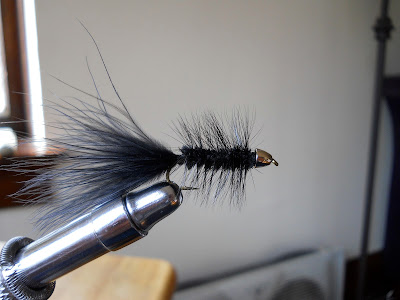
This is the first year I've ever spent a lot of time fly fishing for salmon.  I cut the tapered leader down to about three feet and just tied on about six feet of hybrid six pound test.  I used mostly Woolly Buggers, and egg sucking leeches.  I haven't had a chance to use my creation, the Force Choking Leech, very much.  You can find instructions on how to tie it here.  If you're a fly fisherman, you're probably better at it than I am, so I can provide very little instruction.

black and red egg sucking leech
Egg sucking leech with flashabou in the tail

black cat sniffs a streamer in the tying vise
Kittie examines my fly tying skills

black woolly bugger, silver cone head.
Probably the best looking bead head Woolly Bugger
I ever tied.
Salmon and trout can be hard to catch, but you'll remember your first one forever!  I fished for salmon for a few years before I caught my first one, It was October 1, 2002.  It takes time to learn how these fish work.  I can feel the change in the weather that brings the salmon into the streams now,  an instinct I can't explain.  The clouds look a certain way, the air has something different about it.  It took me years of fishing and lots of luck before I even had a salmon bite.  How bad do you want it?

Monday, November 5, 2012

Binders Full of Salmon

See what I did there?  But really, the history of members of the Family Salmonidae in the Great Lakes could fill several binders.  Most species that are common here now are fish that do not occur here naturally, while our native species are represented by diminished populations, hardly representational of their former abundance.  One species has even been driven to extinction.  As an angler, I think it is important to know the history of the fish you fish for to better appreciate them.  So I am going to consolidate binders full of history into a few paragraphs.

The only members of the Family Salmonidae that are native to the Great Lakes are the lake trout (Salvelinus namaycush), the brook trout (Salvelinus fontinalis), the atlantic salmon (Salmo salar), and the arctic grayling (Thymallus arcticus).
The arctic grayling population was decimated by the logging industry and by the stocking of nonnative species.  They have been extinct since the 1930s.  All efforts to reintroduce this beautiful fish to its native streams have failed.
The atlantic salmon was only native to Lake Ontario but they have been stocked in other Great Lakes tributaries with mixed results.  Torch Lake is still stocked with the atlantic salmon in Lower Michigan, and in Upper Michigan, the Saint Marys River between Lake Superior and Lake Huron is supposed to be just about the best atlantic salmon fishing on the continent.
Lake trout were driven to the edge of extinction by overfishing and invasion of the sea lamprey, but efforts to save the species have been successful, even though their population is a fraction of historical levels.
Brook trout are still found in native streams, and stocked in other streams outside of their native range. They only thrive in the most pristine waters, mostly in the upper portions of the Great Lakes and mountain streams.
I'm not sure, but I think some species of whitefish are native to the Great Lakes too.  Other than those few species, all others are nonnative.

Lake trout with lampreys attached

Brook trout

Atlantic salmon

Arctic grayling

The members of the Family Salmonidae that have been introduced into the Great Lakes are the brown trout (Salmo trutta), the rainbow trout (Oncorhynchus mykiss), chinook salmon (Oncorhynchus tshawytscha), coho salmon (Oncorhynchus kisutch), and pink salmon (Oncorhynchus gorbuscha) as well as a lake trout X brook trout hybrid that is commonly referred to as splake.
A German guy, the Baron Friedrich Felix von Behr helped introduce brown trout from his favorite streams of the Black Forest to the USA in the 1880s.  They were first introduced into a tributary of Lower Michigan's Pere Marquette River-- And then from there, just about every imaginable body of water in the nation.  In the Great Lakes, we have both stream resident brown trout, and lake run browns.
Rainbow trout were introduced in a similar fashion to brown trout starting around  the 1860s.  We also have stream resident and lake run rainbows.  Lake run rainbow trout are commonly called steelhead.  Steelhead are one of the most sought after fish in the Great Lakes.
Chinook and coho salmon were introduced into the Great Lakes originally in the 1800s, but they failed to thrive and eventually disappeared, probably because of mismanagement.  Again, chinook and coho were stocked in the Great Lakes to fill the apex predator role left vacant by the waning lake trout population starting in 1966.  With the lake trout on the verge of extinction, invasive species such as the alewife ran rampant, and annually, billions of alewives would die and wash up on the beaches of the Great Lakes.  This was not great for tourism.  But you know what is great for tourism?  Salmon fishing in the Great lakes!  Win win!
In the 1950s, pink salmon were planted in Lake Superior accidentally when about 100 tiny little yearling salmon escaped from a pen while they were being loaded onto a plane headed for Hudson Bay.  Then again, when about 20,000 "excess salmon" yearlings were "disposed of" in a sewage drain-- that led into a stream-- that fed into Lake Superior.  The idea was that the small fish would have no chance at survival amongst the predators of Lake Superior, let alone a sewage drain.  Pink salmon are pretty well established in the Great Lakes today.
Splake are raised in hatcheries and stocked in the Great Lakes almost strictly for sport fishing.  They are bred because they grow faster than either parent species and because they are highly unlikely to breed in the wild.  Since they are so unlikely to breed in the wild, the splake population is easy to control.

Great Lakes brown trout in spawning colors,
late summer 2008.

Great lakes brown in the spring of 2008.

Steelhead

Rainbow trout

One of the prettiest chinooks
I have ever caught,
late summer 2007.

I caught this fish in the spring of 2008.
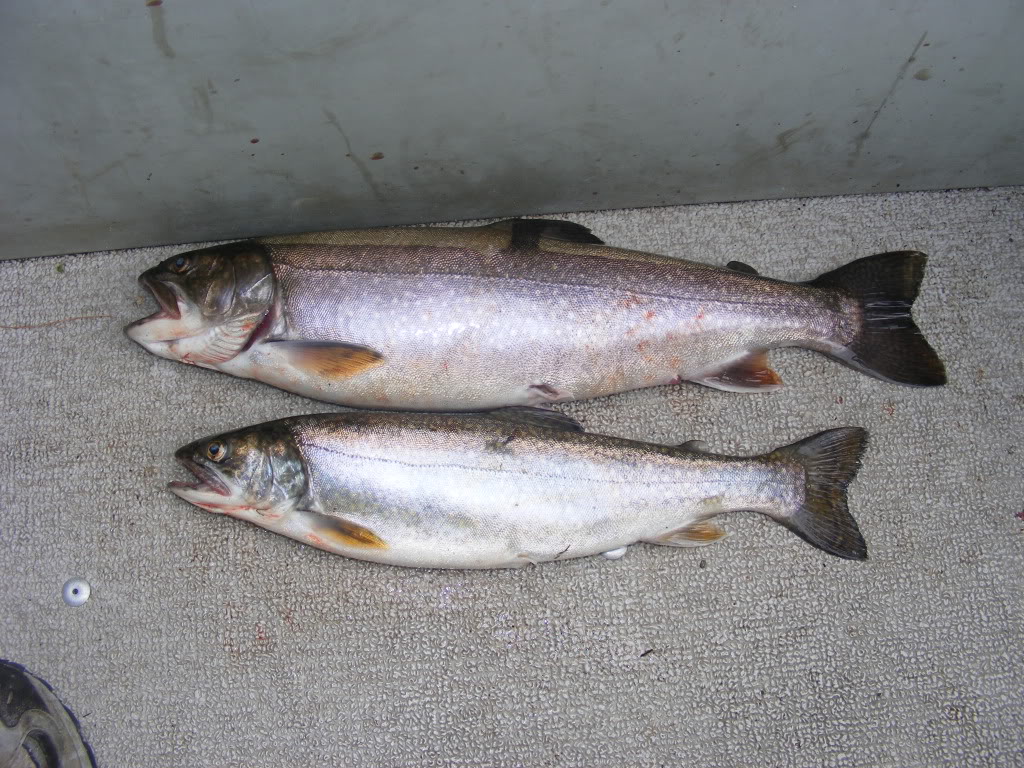
I was never too sure, but I think it's a coho.

Coho

Spawning pink salmon

Splake

It can be pretty hard to identify some salmonids,
this is the guide that comes in the Wisconsin
trout and salmon rulebook.

When I was younger, I believed that the salmon we had in the Great Lakes had to swim all the way in from the Atlantic Ocean-- I just knew they came from the ocean.  Most people probably don't think twice about where the fish come from, or why they're here now.  It's a shame that our native species are so few in our lakes and streams, but we still have most species.  And I'm glad we have the introduced species for now.  Knowing about the history of these fish has made me more appreciative, this is why I practice catch and release the vast majority of the time.  In a later post, I'll talk about catching some of these beautiful fish.  There is nothing like the rush of catching your first chinook in a secluded wooded section of stream in the middle of nowhere.