Showing posts with label walleye. Show all posts

Friday, February 15, 2013

My First Carp

Monday, 4-12-10, 8:10 a.m.

I forgot, my Monday class starts at 8:30, not 8:00.  So I got to class a half hour early.  Oh well, I've done stupider things.
I went fishing yesterday afternoon.  I went near the yacht club.  I saw a few really nice bass, but they were mostly uninterested in what I was offering.  One showed moderate interest in a Wildeye Bluegill.  I caught a big carp on the same Wildeye Bluegill.  Hooked him right in the mouth!  I thought I snagged him, but he was legal.  I saw a walleye laying motionless on the bottom, I could not get him to bite anything!  he looked to be a good size too!  I'd say bigger than 18".


Thursday, August 30, 2012

Keep Calm And Carry Wildeye Swim Baits


I’m positive that you will enhance your fishing experience once you’ve gotten the hang of fishing with curly tail grubs.  When you fish with live bait, the bait does the fishing, but when you fish artificials, you do the do the fishing by making the lure resemble something they want to eat; you have to know how the fish think.  The next fishing lure every angler needs in their tackle box uses the slogan, “Think Like A Fish,” it’s the Storm Wildeye Swimbait.  They are soft plastic bodies molded around an internal weight.  There are some pros and cons to these lures, let’s just get the cons out of the way and then we will be free to discuss how truly awesome these things are.

My current Wildeye collection.  Note the sunfish
on the right with the missing tail.

Most Wildeye Swimbaits have a single dorsal (back) hook and a ventral (belly) treble hook.  The treble hook tends to get snagged a lot.  When fishing in areas with a lot of snags, you can take the treble hook off; it’s only attached with a split ring.  The lure isn’t quite as effective without the treble hook, but it’s better to lose fish than to lose lures.  Also, a big fish tends to wreck these lures in a fight.  The soft portion may be torn from the solid center, the tail may be bitten off, or the lead weight may be knocked loose from the dorsal hook.  Honestly, any fish you can catch that’s big enough to wreck a lure is something to be proud of.  Release the fish, and keep the lure as a trophy.  And the final issue has to do with quality control.  Sometimes you will get a lure that won’t swim straight, or the tail won’t move during the retrieval.  I’m not sure if it’s the packaging or the production.

Ventral hook removed.

Despite these setbacks, Wildeyes are amazing lures!  They are usually sold in packs of three, and usually cost around $5.00.  They are shaped and painted in many different body styles to resemble a wide variety of small fish that big fish eat, so these things attract just about any kind of fish that may occasionally eat smaller fish, and they are pretty easy to use, just cast out and reel in.  The tail paddles on the retrieve making it look like a swimming bait fish, hence the name swimbait.  You don’t have to work too hard to impart action into the lure, since the tail does it for you.  The final reason you should have Wildeye Swimbaits in your tackle box is because of the size of the fish they catch.  I am consistently shocked by the monsterous fish caught on these!  The smallest fish caught with these was a 10” musky while bass fishing; to this day, it was the only musky i’ve ever caught.  Here’s my list of fish caught on Wildeye Swimbaits.
  • carp
  • chinook salmon
  • freshwater drum (sheephead)
  • largemouth bass
  • muskellunge
  • northern pike
  • rock bass
  • smallmouth bass
  • splake (brook trout X lake trout hybrid)

Suspending Wildeye
Swim Shad.
In streams for smallmouth bass, I like to use a suspending Swim Shad much like I’d use a Mister Twister.  Cast upstream ahead of pools, or along cover likely to hold fish.  The suspending Swim Shad sinks ever so slowly as the current carries it through the pool and into the mouths of hungry fish.  When I “Think Like A Fish,” I imagine the bass think it’s a dazed minnow, and they can’t pass it up!

In the Great Lakes region, when the salmon are running up the streams in late summer, I like to cast a weighted walleye Wildeye (walleye Wildeye, walleye Wildeye, walleye Wildeye) into deep holes just before dusk.  The eyes of the walleye pattern glow in the dark, and this drives the salmon crazy, and they will strike out of anger!  A lot of times there will be deep holes under overpasses that hold big chinook.  If you’re ever driving over a bridge in the fall and notice cars parked all along it, chances are pretty good that the salmon are running.

West Michigan's White River under the countyline bridge.


White River from the bridge.


This beautiful chinook took a Wildeye walleye.

My cute little wife talks to seagulls
along the inner Muskegon Channel pier.
Another place I love Wildeye Swimbaits is deep channels and harbors.  Use a sunfish pattern; you can cast them along the rocks of the breakwater and reel them back in to try to lure out largemouth or pike.  You’ll want to retrieve right away when the lure hits the water to avoid getting hung up on rocks and driftwood.  Fishing along the rocks is fun and effective, but what I usually do in the channels and harbors is cast out as far as I can and let it sink to the bottom.  Reel back just fast enough to make the tail move, give some little rod tip twitches, and HOLD ON!  You’ll never know what you’re going to catch, but you’ll definitely know when a fish is on.  I caught so many big sheephead out of the Muskegon Lake Channel on these.  I know sheephead are not the most sought after fish, even considered “rough fish” (more on rough fish in a later update) but they are among the strongest fish I have ever caught!  The long casting technique was how I was fishing when I caught a 24” splake. Such a beautiful fish, and I didn’t have a camera with me.

In Great Lakes marinas, like Milwaukee’s McKinley Marina there are usually some nice fish, like bass, brown trout, carp, pike, walleye, and in the fall, salmon, but lots of snags.  If you get hung up, make a mental note of it.  You don’t want to lose your lure on a picnic table that someone used for ice fishing that didn’t get removed before the thaw, but it probably provides cover for a really nice bass, be careful!  Fish love the shade provided by docks, and the shoreline has some nice rocks for cover.  “Think Like A Fish” and have fun, I bet you can figure it out!

even carp will strike these! notice the sunfish
Wildeye in his mouth.

same fish, Mckinley Marina, 2010

There is one more lure that everyone needs in their tackle box that I will talk about in my next post.  It’s sort of a last resort, when you don’t know what the fish will strike, you’ll be glad to have this Jedi Master of a lure in your arsenal.  Hope the suspense doesn’t kill you!

Friday, August 24, 2012

The Straight Talk on Curly Tail Grubs


assorted curly tail grubs
My collection.
The first lure that every angler needs is the Mister Twister Curly Tail Grub.  Mister Twisters are very natural appearing soft plastic and the slightest movement in the water will cause lifelike motion in the tail.  You can get a package of 20 Mister Twisters for around $3.00, there are also variety packs with several colors.  You’ll need to buy jig heads as well but those are also super cheap.

Since you have to rig Mister Twisters yourself, they are highly customizable.  You can get heads painted in colors that stand out from the color of the lure, or heads that have eyes painted on them.  I usually get very small unpainted jig heads.  Mister Twisters come in many colors, with the most effective being chartreuse flake, pumpkin pepper, purple, and black, but they are all good.
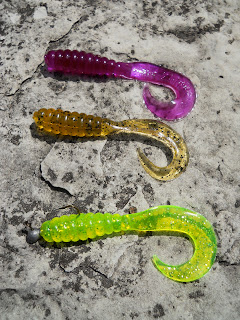
three curly tail grubs
purple, pumpkin pepper,
and chartreuse flake.  I
ran all out of black.
When rigging, make sure the hook
goes the opposite way of
the tail.
Rigged like this, the tail is more
likely to get hung up 
on the hook.


The most amazing thing about Mister Twisters is that they catch just about anything!  Here is a list of fish I have caught on them.
  • Bluegill
  • Sunfish
  • Crappie
  • perch
  • rock bass
  • bullhead
  • creek chub
  • smallmouth bass
  • largemouth bass
  • northern pike
  • walleye
  • sucker
  • carp


When fishing in a bass stream or river, I like to use the smallest jig head I can cast.  Cast them up and across the current to the head of a deeper pocket, or just alongside cover likely to hold fish.  The lighter head makes the lure sink very slowly and naturally in the moving water.  I retrieve the line just fast enough to keep it tight while my lure bounces across the bottom, and if the line goes tight, set the hook!  In the Milwaukee, I’ve caught many smallmouth, some nice rock bass, one 24” carp, and even walleye using this method.  One day earlier this summer, my dad and I caught about 40 fish in the Milwaukee River in just a few morning hours.  My dad borrowed my spinning rod and used Mister Twisters, I used my fly rod and Woolly Buggers.  It was seriously like video game fishing!

Smallmouth on a hand tied Woolly Bugger while
fishing with dad.
One of dad's smallmouths on a
Mister Twister

Nice one!

Nice sized rock bass on the fly.
Beautiful fish.
Rock bass on a Mister Twister.
Chartreuse flake FTW!

When I lived in Michigan, I would fish the rocky walls of the Muskegon Lake Channel using Mister Twisters under a float with good success.  In this situation, a bigger jig head can be used.  The float would go about 4’ above the lure, then cast almost parallel to the rock wall.  The ebb and flow of the water between Lake Michigan and Muskegon Lake will keep your float and lure moving along the rocks while the waves give it vertical motion.  The lure will present itself to spaces between the rocks and dark hollows where panfish, largemouth bass and rock bass love to hide.  If your float disappears under the water, set the hook!  This technique also works along the rocks in Veteran’s Park in Milwaukee, or out on the rocky section of the breakwater, and even right in front of the Milwaukee Art Museum!  Don’t be afraid to climb out on the rocks, find one that looks fairly level and sturdy and make it your home.


A dreary summer day under the Art Museum

The wings of the museum close and open at noon.

This big perch took a black Mister Twister

The rocks along Veteran's Park with
the breakwater in the background.
So much cover for fish.

When I'm in Michigan, My dad, my brothers and I would go out in my dad’s fishing boat and fish in inland lakes.  Most of the time we’d go to Twin Lake on weekday evenings.  Twin Lake is close to home and not too big, so it doesn’t get a lot of fishing pressure during the week.  On the water, you simply cast your line out, then let the breeze push the boat.  You can give your lure some twitches by lifting the tip of your rod occasionally, but a lot of times, that isn’t even necessary.  Largemouth bass or northern pike won’t hesitate to suck up a purple Mister Twister just crawling by at a snail’s pace.  When Kyle, my youngest brother was just a little toddler, we wanted him to feel like he was fishing.  What we did was gave him a yard sale kid’s rod with a brown Mister Twister on a huge orange jig head (we called them “pumpkin heads”) and let his line drop about 8’ below the surface, just to make him feel like he was fishing.  The waves kept his lure moving up and down, and wouldn’t you know it, he caught the biggest bass of the day “pretending to fish.”  It must have been 17” long!  Poor little boy, it scared the crap out of him!  I still remember him crying out “Put that whale back!”  

Magician Lake.  Kyle's all grown up now.  My dad and my other
brother Shane in the background.

If you don’t have access to a boat, fishing from shore is still a lot of fun.  Cast toward docks, lily pads, downed trees, anything that gives fish cover.  You can also just cast out and steady retrieve your line back in, big bluegill will give chase!

Because of their affordable price and effectiveness for so many species, if you are only going to fish with one artificial lure, Mister Twisters are the one.  But i’m betting, once you get into fishing with artificials, you’ll be hooked!