Wednesday, December 12, 2012

Basic Fly Tying Techniques and Tying The San Juan Worm

When you first get started fly tying, there are two techniques that are the same for just about every fly, how you start the fly, and how you finish it.  Once you know how to do those two things, techniques can be learned on a case by case basis; mostly, it's just wrapping thread around stuff.

Getting the thread started on a hook is way simpler than you could ever imagine.  There is no tying involved, just wrapping thread.  To try to explain it would make it sound way more complicated than it ever is, so I demonstrate the technique in the following video.  Excuse the shaky cam,  I literally just set my Nikon L24 on a stack of books on a T.V. tray.


Finishing up the fly is more complicated.  The handbook that came with my kit teaches a knot that just does not hold unless cemented with head cement, and a lot of videos on Youtube showed guys tying a knot with a "Whip Finishing Tool."  I didn't have this tool, so I found instructions on how to whip finish by hand, but the videos were all done so fast that I couldn't clearly see what was being done.  My whip finish kept coming undone until I finally figured out where I was going wrong.  Now I whip finish by hand, and my knot holds just fine with no cement. In my opinion, the tool seems to overly complicate things.  To try to give written instructions on how to whip finish by hand would be hard to do, and even harder to follow--I know by experience--so here is a demonstrational video.


Ok, now with just those two techniques, some scud hooks, some thread, some chenille and a lighter, you are ready to tie the San Juan Worm.  I tried to do some research to find out a little background for this simple-yet-effective fly.  I wouldn't call it a streamer, it's not a wet fly, definitely not a dry-- It's more of a nymph than anything else, but it's not even really a nymph.  This link gives some interesting background information on the San Juan Worm.  I usually tie them with a size 12 or 14 scud hook with a downturned eye.  Scud hooks have a curved shank, rather than being straight.  Below is a three minute video demonstrating how to tie the San Juan Worm.


When fishing in a stream with a San Juan Worm, I cast to the head of a pool and let it dead drift through the pool.  They work well after the rain when worms get washed into the stream, I don't use them a lot, but when I do, I catch smallmouth bass.  I've never tried fishing for trout with them, but I don't really get to go trout fishing as often as I'd like to.  If you have any questions about tying flies, leave a message, I'll try to answer what I can.

Monday, December 10, 2012

Tying Flies When You're Having Fun

Makeshift mancave
Catching fish on your own flies is a lot more rewarding than catching them on flies you bought.  Fly tying can be as simple or as complicated as you want to make it.  I started with a Gander Mountain fly tying starter kit that included a tying vise and other tools, hooks, some materials, and a handbook; it cost about $50.00.  I still use all of the same equipment, although I hope to upgrade someday.  In this post, I'm going to talk about the essential tools and materials for tying a few flies that I have found to be particularly successful.

The tools I use for almost every fly are listed below.
  • Tying vise
  • Bobbin
  • Scissors
  • Hackle pliers
  • Bodkin
assorted fly tying tools and hooks

The vise, bobbin and scissors are the most essential.  Hackle pliers are really helpful for holding tiny hackle feathers for dry flies, or even just holding larger feathers out of the way while working other materials in.  In a pinch, you could probably get by with forceps or a clothespin.  The bodkin is used for many things, but you could probably improvise with a safety pin or a sewing needle.  Of course you'll need a mug of coffee, and some music too.  I find myself listening to a lot of Primus when tying flies, but really, anything southern or kind of twangy or nautical themed makes for good fly tying music.  Mastodon's Leviathan album is a good one if you like a little heavier music; it's a concept album based on the novel Moby Dick.

Of course you are going to need some hooks, and some materials for tying.  The following is a list of the materials I use most.
  • Thread
  • Chenille
  • Hackle feathers
  • Marabou feathers
  • Dubbing
  • Copper wire
  • Beads
  • Flashabou
I probably don't need to tell you that you will use thread on every fly you tie--but I will.  I use black the most, but I make sure to always have red, olive, and tan on hand.  Some people have a bobbin for each spool of thread, but I just use one.  Copper wire is used to add a segmented look to the bodies of some flies, or just to add flash and color.

assorted spools
Fly tying thread and wire

Chenille is a soft yarn used to make bodies of flies.  I use it a lot, because I tie a lot of Woolly Buggers.  I always have black, olive and red in my ITEM list.  Woolly Buggers are great flies for trout, bass, and many other kinds of fish.  If you only ever learn to tie one fly, it should be the Woolly Bugger.

black olive, and red
Assorted fly tying chenille

Different grades of hackle are used for different flies.  Neck hackle is used mostly in tying dry flies; the short, stiff bristles make the fly float on the surface and mimic insect legs in the water.  Saddle hackle is usually not considered high enough quality for tying dry flies, so it is usually used in streamers to make the fly appear to be swimming or pulsating in the water.  Soft hackle is used in a lot of wet flies.  I use saddle hackle mostly, because it is used in Woolly Buggers.  I haven't tied a lot of dry flies.

A neck of red hackle in the center,
Black and grizzly saddle hackle on either side
Marabou feathers are very soft feathers that absorb water rather quickly.  They add a lot of very natural appearing movement in the current.  They are used in the tails of Woolly Buggers and some other streamers.  I make sure to have black and olive marabou in my collection for tying Woolly Buggers in those colors.

Black and green marabou
Marabou is very soft
Dubbing is used in a lot of flies.  there are going to be nymphs, dries, streamers, and wet flies that all call for dubbing.  Dubbing is fur from soft furred animals that is wound around the tying thread and used to build up the body of the fly.  In early fly tying, most salmon flies called for seal fur-- good luck finding that!  Dubbing today is made from the fur of animals like opossums, beavers and rabbits-- I've been tempted to try using hair from my cat, but haven't yet.  I use dubbing most often in tying scuds.  Scuds are tiny freshwater shrimp that fish regularly feed on.  Scuds are fairly simple to tie, require only a few materials, and very effective for trout and bass when dead drifted.

olive, grey, and tan
Olive, grey, and tan dubbing
Beads are used as the heads of nymphs and streamers.  They add a little bit of weight to sink the fly faster, and add flash and color.  I'm not sure, but I think the idea of using beads is a fairly new innovation to fly tying.  In earlier times, (and even still) some streamers called for lead wire to be wrapped around the hook shank.  My fly tying kit even came with some lead wire for use in Woolly Buggers.  But with the added flash and color of bead heads, there is no need for anglers to be further polluting our streams by adding lead to the ecosystem.  Not only are beads safer for the environment, they also seem to improve the effectiveness of most flies when used in appropriate sizes.  I keep several shapes, sizes and colors.  Use heavier beads on big Woolly Buggers in swift currents and deep pools, smaller beads can be used on tiny nymphs and scuds dead drifted in slower water.

and assortment of beads and flashabou
Assorted bead heads and flashabou
Flashabou is a synthetic material that has a prismatic or iridescent pearly reflective quality. A few strands of flashabou in the tail of a Woolly Bugger may help attract fish to your fly.  It doesn't take a lot, I've had the package pictured above for about three years and I've hardly used any!  A package of flashabou is a good investment.

I have some other materials that are used in particular flies that I don't tie so often, but it's nice to have them if you need them.  Pheasant tail feathers are used in tying Pheasant Tail Nymphs and Copper Johns.  Pheasant Tail Nymphs are highly effective, but they are not easy to tie, at least for me.  They're tiny, and they test my patience-- but a Pheasant Tail was the first fly I tied that I caught a trout on!  Peacock Herl is used in a lot of flies, and fish love it.  Anything with peacock herl in it  is going to be an effective fly.  You can tie peacock herl on a hook by itself and it will catch fish.  Common flies that call for peacock herl are the Royal Coachman, Pheasant Tail Nymphs, and Prince Nymphs.  I have some goose biots because Prince Nymphs call for two white goose biots.  However, the goose biots I have are from Canada geese.  I found them in the park, so I'll improvise.  Finally, I have some elk hair.  Elk hair is used in a legendary dry fly, the Elk Hair Caddis.  When you want to catch fish on a dry fly, the Elk Hair Caddis is probably what you would tie on first if there isn't any kind of hatch to match.  The Elk Hair Caddis is quite tricky to tie.  I haven't quite gotten the hang of it yet.  The hair is very stiff and it's hard to get used to working with it.  There are other flies that use elk hair as well, like the Muddler Minnow.  I tried tying a Muddler Minnow.  It didn't turn out great, and I never caught a fish with it.
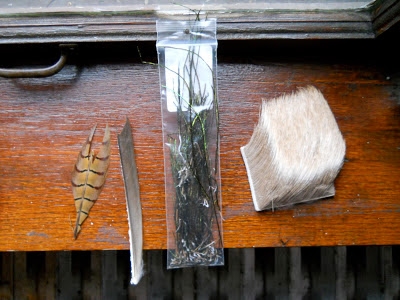
Various feathers, elk hair for fly tying
From left to right: Pheasant tail, goose biot,
peacock herl, and elk hair
It's also helpful to have some sort of a book to explain how to tie flies.  The Milwaukee Public Library has a pretty good selection of fly fishing and fly tying books at the central location.  I recently checked out a book titled Salmon Flies: Their Character, Style and Dressing by Poul Jorgensen.  The book is beautiful with some of the most intricate flies I have ever seen, but it requires complicated techniques and materials from exotic animals.  There is a chapter called "Simple Strip-Wing Flies" that explains how to tie the Blue Charm in 43 steps, using 11 materials!  I think there was a fly in the book that called for moogle dubbing, Cockatrice pinion, Chocobo hackle and Phoenix Down!  The book is so complicated that to a fly tyer of my skill level, it reads like a work of fiction.  Most flies are far simpler.  My kit came with a handbook that gave instructions on how to tie flies that will catch fish using just two or three materials.
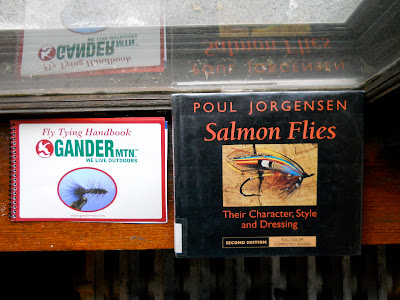
2 books
The extremes of fly tying
If you're looking to get into tying, the materials that you will probably get the most use out of are chenille, some hackle, dubbing and marabou.  With just those few materials, you can tie a few very successful flies.  You can get them at any Gander Mountain or Cabela's.  If you live in the Milwaukee area, you can get great materials, good advice, and even take a tying class at The Fly Fishers.  In my next post, I'll demonstrate some basic fly tying techniques, and give instructions on how to tie an effective fly using only two materials.

Tuesday, December 4, 2012

It's a Three Piece Now!

Tragedy

While walking along the concrete bank of the Menomonee, I slipped and fell.  I didn't hurt myself at all, so I dusted myself off and continued walking.  Then I noticed a small twig entangled in my leader.  I reached to untangle it, then I noticed that it wasn't a twig at all, it was the tip of someone else's fly rod that had been tangled in my line, how strange!  It's really not too surprising, there are pieces of broken rods all over down there.  Then I had that sick feeling in my viscera, I looked up at the tip of my rod to find my suspicion correct, the tip hanging from the leader was in fact, mine.  It's not even a nice fly rod, it's just all I have!  I turn around and head home, fighting back tears.

Comedy

The next day, I start dreaming of having unlimited gil, and start looking at rods online.  I am mostly just talking to myself, but my wife knows how upset I am, so she's trying to care about my hobby.  I'm showing her which rods I wish I could afford and which ones I'll probably have to settle for.  I said something about wanting another two piece, but maybe a four piece would fit in the trunk better.  My wife says "I thought you had a three piece."  I respond "It's a three piece now!"  My wife bursts into hysterical laughter, I chuckle a little myself.  You have to laugh in these situations to keep from crying.


My rod was a Cabela's 8'6" 5wt Wind River With a Three Forks 4/5/6 reel.  I caught a lot of fish with it.  Mostly smallmouth bass, but plenty of trout too, and some pretty big salmon.  I think it's time to save up for a big boy rod now.

Thursday, November 22, 2012

Keepers

We went fishing as a family this Thanksgiving for only the second time.  My wife doesn't actually fish, but she makes a great photographer.  You can check out her blog if you want.

Lilyhammer hides from the sun


Christina does not like fishing

The Menomonee River


Lilyhammer loves daddy's hat string

Amazing graffiti

...F stands for failure

Not the most scenic stretch of river

The fishing was slow and I didn't even have a bite, but I still have a couple of keepers.

Win Win

Should I go out and not catch any fish, or should I stay home and watch the Lions lose?

Tuesday, November 20, 2012

Beers, Brothers and Broken Rods

Earlier in the fall, my wife accidentally slammed my only remaining spinning rod in the trunk of our VW.  Me, seeing that the dashboard lamp indicating that the trunk was ajar, opened the trunk and slammed my rod in it again.
To be honest, I did not care much for the rod.  It was a Shakespear Tiger Spinning rod, available exclusively at Walmart.  It was cheap, and it brought in a lot of fish.  The rod was cracked pretty severely just below the female ferrule, but it wasn't totally broken; I was going to fish with it until it met its end.
I'd prefer to fly fish, but I will not fly fish with my 8 month old daughter on my chest-- I don't trust my fly casting ability-- and most opportunities I have to fish are with her when I take her for walks.  Despite the damage, the rod still landed some serious salmon out of the Menomonee River!  But finally, in the end, it was a 22" coho that did it in.  I still landed the fish.


My brother has been trying to make a trip to our side of the lake since August, but a new position at his job made finding a free weekend unpredictable.  After my rod broke, I told my dad and he has more gear than he knows what to do with in his mancave.  He had a couple of old rods that he was going to send with my brother when he finally came.  Shane usually has his head in the clouds, but he likes to get on the water occasionally when he's not flying.  We were planning hitting the Milwaukee for smallmouth in the summer, but salmon are prevalent in the Menomonee even so late in the fall.

Me and Shane, 2009

Shane after flying an Extra 300

Magician Lake Bass trip, 2012

Shane showed up late friday, we went to Cafe Hollander for beers and conversation.  after the beers, we skipped stones in the river for way too long before calling it a night-- it's so much more fun after a couple beers.  The next morning, I swapped the reel on one of the rods my dad sent for my nicer one.  Shane, Lilyhammer and myself walked out the front door and hit the Menomonee while my wife stayed home.  We walked for a mile or so before we saw fish, and then it wasn't long before I had one on.  I instantly asked Shane if he wanted to land the fish-- He had never caught a salmon.  He said "I don't not want to land the fish," or something along those lines.  Lily and I readied the net, Shane took the line.  Shane eventually brought the fish to the to the net, the fish came ashore, pictures were snapped and the fish was released.

Shane's salmon

He wanted to see me catch one, but I couldn't get another fish to bite.  That's fine though, I've caught a dozen or so this season.  There will probably be a couple more before the weather gets really cold, and then there is the spring steelhead run!

Friday, November 9, 2012

Never Underestimate The Power of The Dark Side

Egg sucking leeches are great flies.  They are just a variation on a Woolly Bugger, which is arguably the most effective streamer of all time.  There is, however, one variation that drives me crazy, and that is the bead head egg sucking leech.  Whether it happens or not, I can picture a leech creeping up through the river bed and latching onto a salmon egg; and I can picture how enticing this two course combo meal would be to a steelhead.  Like getting orange chicken and beef and broccoli at Panda Express!  But then if you throw a bead in there, I can't wrap my imagination around that.

I'm sure it works, but...

Enter my contribution to the fly tying world:  The Force Choking Leech!  I found some black cone head beads and got the idea to tie the egg onto the hook first with red thread, then whip finish it.  Then add a bead, but I put the bead on backwards.  


egg sucking leech

Next, I tie on black thread, tie in black marabou for the tail , black chenille and a black hackle feather for the body.


Wrap the chenille and the hackle forward towards the bead as you would a Woolly Bugger, and tie them off.  I wrap a lot of thread to build up a smooth taper onto the head, but I do that before tying in the extra stuff.


Whip finish the black thread just behind the bead and you're done.  Welcome to the Dark Side, now go choke some fish!

I came up with the name in that haze between sleep and consciousness, before the alarm goes off, but you know it's going to go off soon--  The black bead reminded me of Darth Vader's helmet.  From there, the "egg" is red, like Vader's lightsaber, and, the body is black, like the Sith Lord himself.

I haven't really tied a lot of these.  I'm going to experiment with some other bead colors, but I like the look of the all black and red.  Maybe olive with a gold bead and a black egg, who knows?

If you've never tied flies before, I'll discuss what is absolutely needed and what you can do without in a later post.  I also have a few flies that I will try to teach you to tie.  some are so easy, you probably won't even believe they catch fish.