Monday, November 5, 2012

Binders Full of Salmon

See what I did there?  But really, the history of members of the Family Salmonidae in the Great Lakes could fill several binders.  Most species that are common here now are fish that do not occur here naturally, while our native species are represented by diminished populations, hardly representational of their former abundance.  One species has even been driven to extinction.  As an angler, I think it is important to know the history of the fish you fish for to better appreciate them.  So I am going to consolidate binders full of history into a few paragraphs.

The only members of the Family Salmonidae that are native to the Great Lakes are the lake trout (Salvelinus namaycush), the brook trout (Salvelinus fontinalis), the atlantic salmon (Salmo salar), and the arctic grayling (Thymallus arcticus).
The arctic grayling population was decimated by the logging industry and by the stocking of nonnative species.  They have been extinct since the 1930s.  All efforts to reintroduce this beautiful fish to its native streams have failed.
The atlantic salmon was only native to Lake Ontario but they have been stocked in other Great Lakes tributaries with mixed results.  Torch Lake is still stocked with the atlantic salmon in Lower Michigan, and in Upper Michigan, the Saint Marys River between Lake Superior and Lake Huron is supposed to be just about the best atlantic salmon fishing on the continent.
Lake trout were driven to the edge of extinction by overfishing and invasion of the sea lamprey, but efforts to save the species have been successful, even though their population is a fraction of historical levels.
Brook trout are still found in native streams, and stocked in other streams outside of their native range. They only thrive in the most pristine waters, mostly in the upper portions of the Great Lakes and mountain streams.
I'm not sure, but I think some species of whitefish are native to the Great Lakes too.  Other than those few species, all others are nonnative.

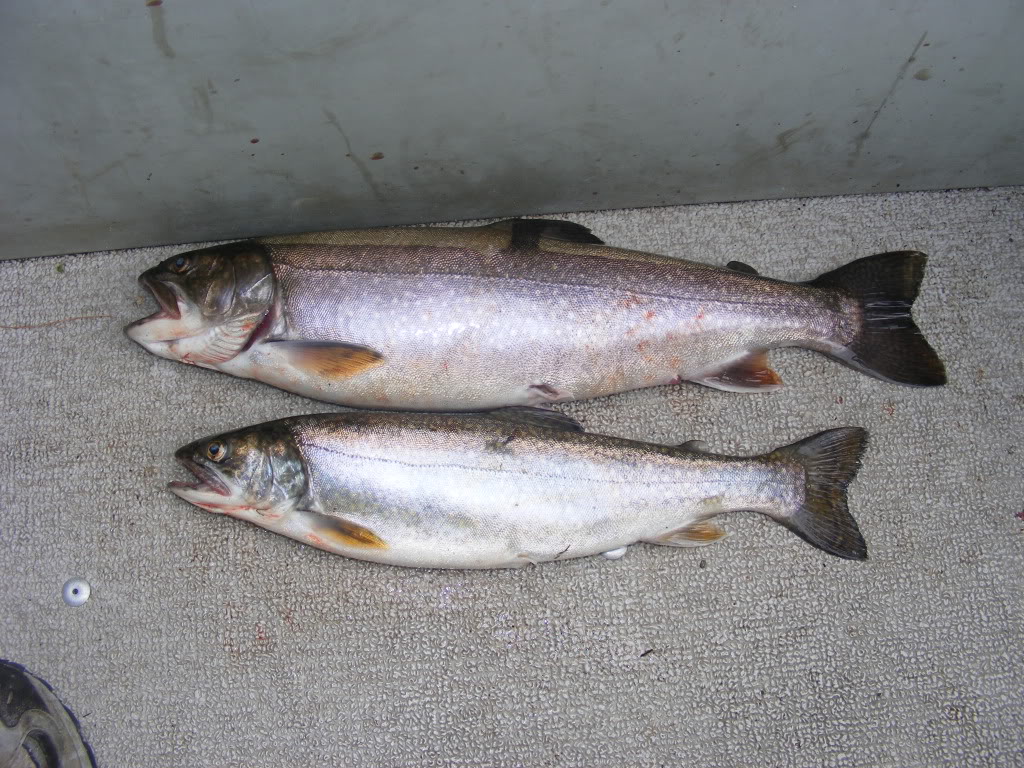
Lake trout with lampreys attached

Brook trout

Atlantic salmon

Arctic grayling

The members of the Family Salmonidae that have been introduced into the Great Lakes are the brown trout (Salmo trutta), the rainbow trout (Oncorhynchus mykiss), chinook salmon (Oncorhynchus tshawytscha), coho salmon (Oncorhynchus kisutch), and pink salmon (Oncorhynchus gorbuscha) as well as a lake trout X brook trout hybrid that is commonly referred to as splake.
A German guy, the Baron Friedrich Felix von Behr helped introduce brown trout from his favorite streams of the Black Forest to the USA in the 1880s.  They were first introduced into a tributary of Lower Michigan's Pere Marquette River-- And then from there, just about every imaginable body of water in the nation.  In the Great Lakes, we have both stream resident brown trout, and lake run browns.
Rainbow trout were introduced in a similar fashion to brown trout starting around  the 1860s.  We also have stream resident and lake run rainbows.  Lake run rainbow trout are commonly called steelhead.  Steelhead are one of the most sought after fish in the Great Lakes.
Chinook and coho salmon were introduced into the Great Lakes originally in the 1800s, but they failed to thrive and eventually disappeared, probably because of mismanagement.  Again, chinook and coho were stocked in the Great Lakes to fill the apex predator role left vacant by the waning lake trout population starting in 1966.  With the lake trout on the verge of extinction, invasive species such as the alewife ran rampant, and annually, billions of alewives would die and wash up on the beaches of the Great Lakes.  This was not great for tourism.  But you know what is great for tourism?  Salmon fishing in the Great lakes!  Win win!
In the 1950s, pink salmon were planted in Lake Superior accidentally when about 100 tiny little yearling salmon escaped from a pen while they were being loaded onto a plane headed for Hudson Bay.  Then again, when about 20,000 "excess salmon" yearlings were "disposed of" in a sewage drain-- that led into a stream-- that fed into Lake Superior.  The idea was that the small fish would have no chance at survival amongst the predators of Lake Superior, let alone a sewage drain.  Pink salmon are pretty well established in the Great Lakes today.
Splake are raised in hatcheries and stocked in the Great Lakes almost strictly for sport fishing.  They are bred because they grow faster than either parent species and because they are highly unlikely to breed in the wild.  Since they are so unlikely to breed in the wild, the splake population is easy to control.

Great Lakes brown trout in spawning colors,
late summer 2008.

Great lakes brown in the spring of 2008.

Steelhead

Rainbow trout

One of the prettiest chinooks
I have ever caught,
late summer 2007.

I caught this fish in the spring of 2008.
I was never too sure, but I think it's a coho.

Coho

Spawning pink salmon

Splake

It can be pretty hard to identify some salmonids,
this is the guide that comes in the Wisconsin
trout and salmon rulebook.

When I was younger, I believed that the salmon we had in the Great Lakes had to swim all the way in from the Atlantic Ocean-- I just knew they came from the ocean.  Most people probably don't think twice about where the fish come from, or why they're here now.  It's a shame that our native species are so few in our lakes and streams, but we still have most species.  And I'm glad we have the introduced species for now.  Knowing about the history of these fish has made me more appreciative, this is why I practice catch and release the vast majority of the time.  In a later post, I'll talk about catching some of these beautiful fish.  There is nothing like the rush of catching your first chinook in a secluded wooded section of stream in the middle of nowhere.

Friday, October 5, 2012

I Don't Know How Much Longer I Can Hold This

All this time we've lived in our new apartment, I would always go upstream to fish the more natural stretches of the Menomonee River.  Keep in mind, "more natural" is a relative term, meaning, much less concrete and spray paint.

I had errands to run, which brought me near a park along the Menomonee about two miles farther downstream from where I usually fish.  I parked my car, got my gear,  jumped the wall, and saw fish everywhere.  Suckers, salmon and pike all over among the piles of "evidence" of so many unsolved, possibly unreported crimes.  Fish finding cover amongst skateboards, refrigerators, a stop sign, construction barrels, bicycles, chef's knives, chef's knives?  CHEF'S KNIVES!  I start casting, but it's a tough crowd.  The pike are amongst the suckers, why would they chase a swimbait?  I walked a ways up and down stream, amazed by the size of the fish I saw, but time was short, and after this, I knew where to find fish.  This kind of water is all new to me!  It reminds me of the motorcycle chase scene from Terminator 2.  The lower urban stretch is still within walking distance, I've always just been walking the wrong way, a return trip would be necessary.


A pair of northern pike.

Click to enlarge.
The weekend found me in the concrete canyon of the lower stretch of the Menomonee River an awful lot.  I had never seen another person down there, but apparently the word is out that the autumn salmon run has begun, despite the catastrophically low water levels.  Instinct can overcome low water, log jams, even miles of concrete and mounds of forensic evidence.  I wasn't ready to fish, I was just there to observe, as were many others.  I only saw one guy catch a fish, a beautiful female.  Saturday evening while walking with my baby in the carrier, we found a sweet fossil.  Weekends are always crazy for salmon fishing, I waited to wet my line until monday.

This guy caught her on a spawn sack.

Pretty awesome trilobite fossil.

Catching a salmon on a fly was something I've always wanted to do, so I tied some egg sucking leeches over the weekend.  I waited until mid morning to hit the stream with my gear, there were salmon everywhere -- and I had the stream to myself.  It wasn't long before I was hooked up with a big female.  She was tired, but still had some spirit!  I landed her and released her above the rapids she was struggling to get over.  A male followed, also released above the rapids.  The third fish fought the hardest; a nice male that ran downstream, forcing me into a thousand yard chase; the concrete bank makes for a great sidewalk.  The fish eventually tired and came in.

One of my hand tied #6 egg sucking leeches.

Fish on!

Nice female

Not as pretty as the female.

Action shot, I was just along for the
ride with this guy.

I love the color of
a spawning male

Resusitating the fish.

Such a beautiful sight, seeing
him swim away,

Three fish landed on the fly, three fish released.  What a great way to start the week.  I followed it up by catching and releasing three more Tuesday on spinning tackle with my baby girl, landing two of them by hand.  All of them were caught on Thundersticks.  One had a gold Little Cleo stuck in its tail that I took out.  Wednesday, I caught and kept a 34" female.  Seven fish in three days, those accomplishments are coming along pretty nicely.

34" salmon 

Achievements unlocked
  1. (*) Gold Hook (Catch a game fish over the minimum length requirement)
  2. (*) Baby Bear (Catch a member of the family: Salmonidae)
  3. (*) Mama Bear (Catch a member of the family: Salmonidae that measures over 30")
ITEM Pickups
  1. GOLDEN LITTLE CLEO
  2. TRILOBITE FOSSIL

Monday, October 1, 2012

Skunked

Last week I got to spend an evening with my beautiful little girl.  She loves being outside, and I had not taken her fishing yet, so I decided we needed to find out if the salmon were running in the Menomonee River yet; maybe I could unlock some of those remaining achievements.  She's just six months old, so I wasn't planning on doing any really serious fishing.
After her nap, we made the two and a half mile trip to the more natural stretch of the river, and she was already being fussy and crabby.  I put her in the carrier on my chest, grabbed my gear out of the trunk and walked to the river.
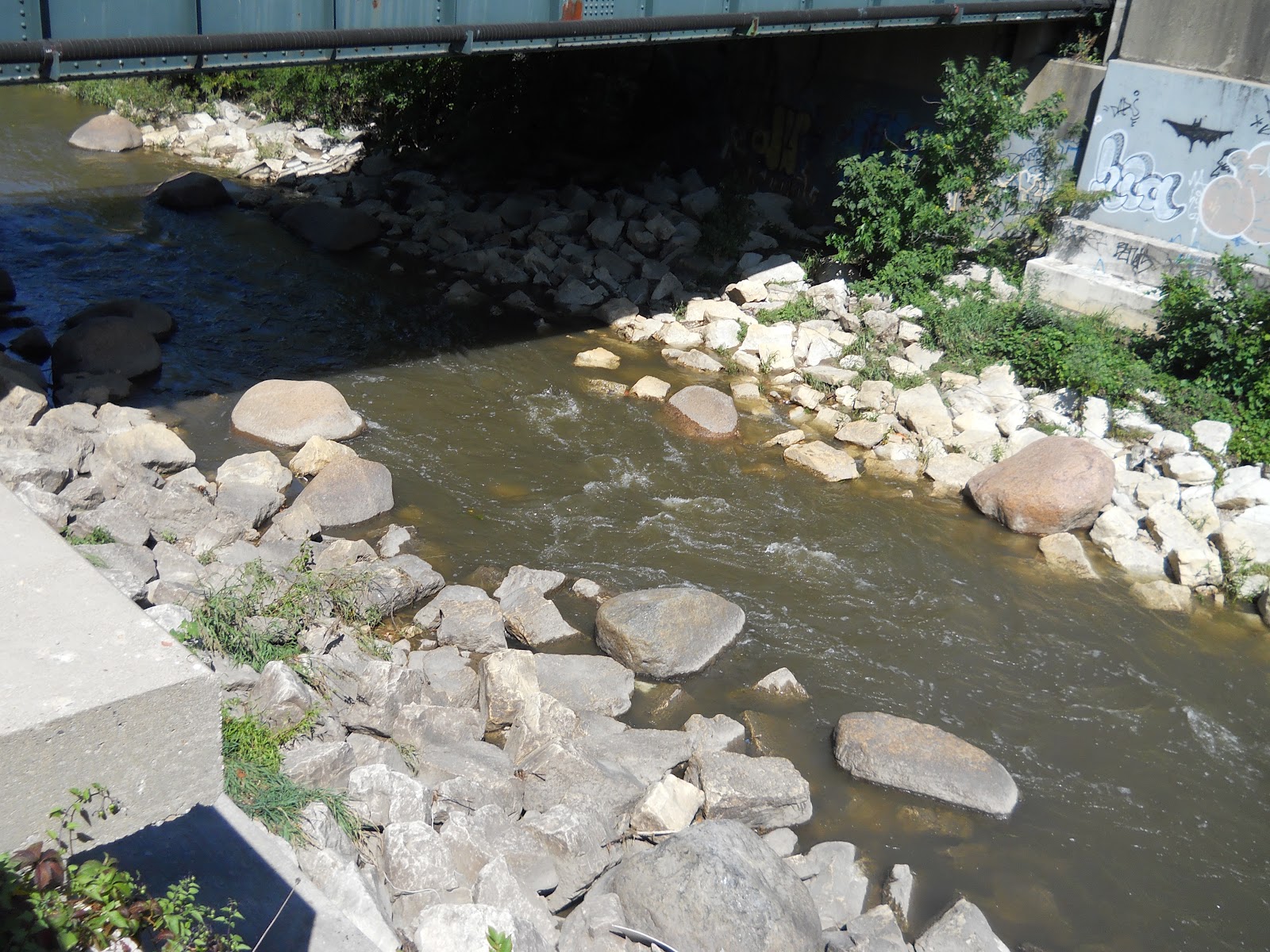
This picture was taken at an earlier date,
the water is even lower now.
The water is terribly low still, but there is a pool where the water cascades over rock, if there are salmon this far up, they will be bottlenecked up in the pool for sure.  My little angel had a good time when we got to the bank, she loves the water, and there were some ducks and frogs for her to see.
I didn't anticipate how much wearing a baby on my chest would effect my cast, but I still managed to get my lure where I wanted it.  I think my girl's favorite part of fishing was watching the reel spin as I retrieved my line.
I managed to fish for ten or fifteen minutes before baby turned into crabby pants and we stopped fishing without so much as seeing a single fish.  We started walking, and she calmed right down, so I dropped the gear back in the trunk and hit the nature trails.  My sweetie fell asleep instantly, I continued to explore the beautiful Jacobus park as she napped.
Tiny stream.

Very nice trails in the park.


She wakes up! 

Baby had a fun time

She eventually woke up and was a happy, cute little angel.  Even though I got skunked, that was the best fishing yet this season.

Saturday, September 22, 2012

Sorry

It's been a long time since I've made a real post.  My family all came down with the flu, some fishing plans with a friend from Australia fell through, and preparing for my phlebotomy clinicals have left me with little spare time.  Several new ideas are being worked upon and new posts will be coming soon, so stay tuned!

Tuesday, September 11, 2012

Mastering the Shadow Cast

Easy to follow instructions for one of the most useful fly casting techniques.


Why does fly fishing have to be so serious?

Friday, September 7, 2012

Leveling Up

The first thing I like to do when my family moves into a new area is find the closest body of water and come up with a list of achievements to "unlock" on said body of water; like playing video games.  Looking for special "ITEMS" to add to your "Inventory" is also fun.  There are two bodies of water within walking distance of our current apartment, the Menomonee River, and the Washington Park Pond.  My achievements to unlock and ITEM pickups are listed below, I'll list the conditions that need to be met to unlock these achievements as I complete them.

Menomonee River
Achievements
  1. (*) Blue Heron (locate three areas likely to hold fish)
  2. (*) Eagle Eye (visually locate fish)
  3. (*) Bronze Hook (catch a fish)
  4. (*) Silver Hook (catch a game fish)
  5. (*) Gold Hook (Catch a game fish over the minimum length requirement [Achievement unlocked 10-1-2012]) 
  6. (*) Cleanup Crew (catch a rough fish)
  7. (*) LATFH (catch a fish on the fly)
  8. (*) Elitist (Catch a fish on a dry fly [Achievement unlocked 09-02-13])
  9. (*) Baby Bear (Catch a member of the family: Salmonidae [Achievement unlocked 10-1-2012])
  10. (*) Mama Bear (Catch a member of the family: Salmonidae that measures over 30" [Achievement unlocked 10-3-2012])
  11. ( ) Papa Bear
  12. ( ) Hungry Bear
ITEM Pickups
  1. FOSSIL FRAGMENT
  2. FOSSILIZED CORAL
  3. DISK GOLF DRIVER
  4. GOLF BALLS

The stretch of the Menomonee River that I live by is very urban, right on the edge of the Menomonee Valley.  People might ask, "Why are you gonna fish in there?"  Because it's there!  It apparently has decent salmon and steelhead runs, and in the past it was stocked with rainbow trout, bass, and pike.  It's too tempting not to fish, and it's a fun place to hang out.

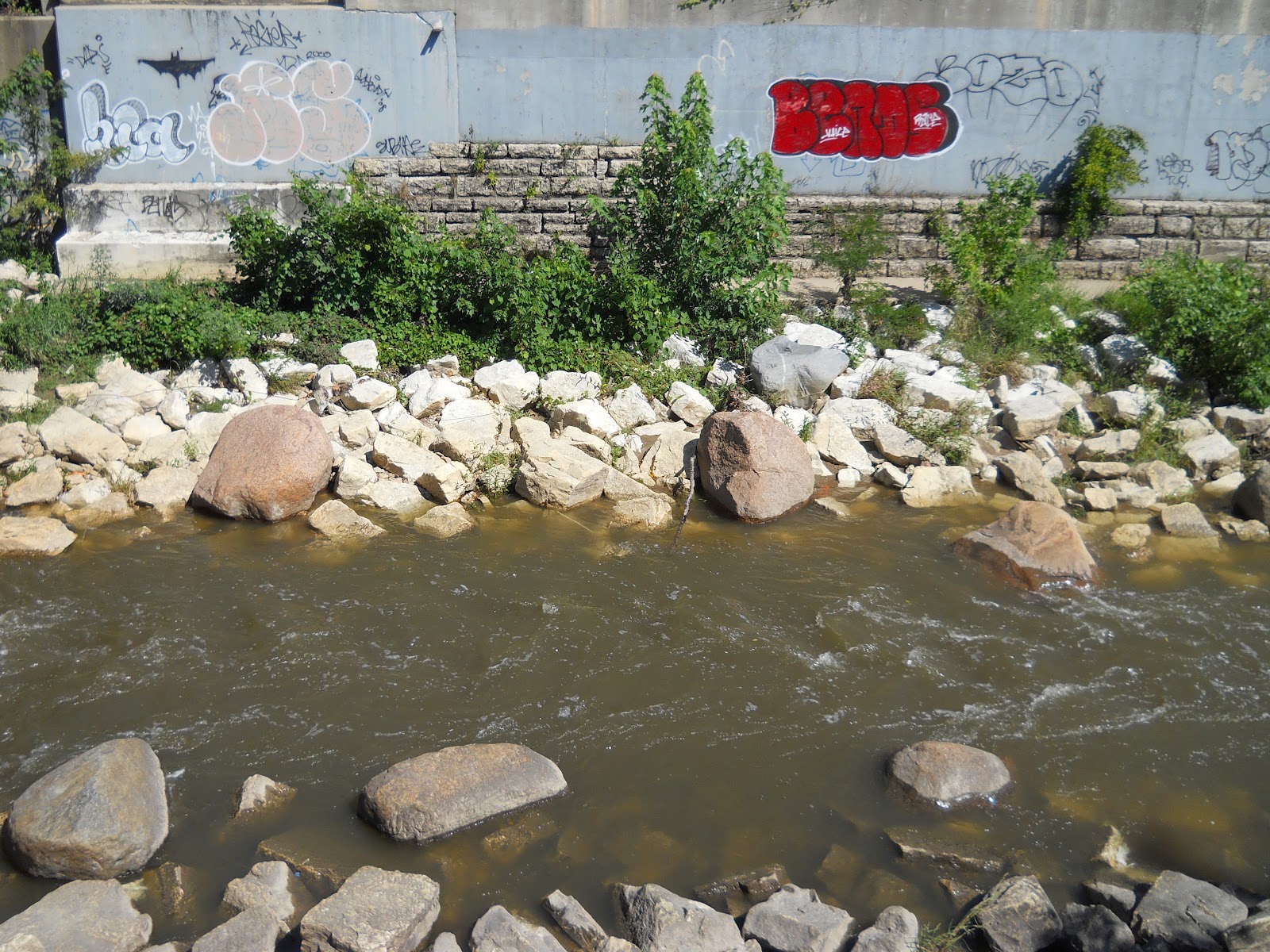
Very urban.

The Menomonee is kind of tucked away and
out of view to most.

My brother Shane throws a golf ball.

After a little rain, it muddies right up.

Looks like dirty dishwater.

As you go upstream, it becomes more natural looking.

So pretty in this stretch.

It doesn't seem to take long to clear up after the rain.

Beautiful remnants of an old bridge

Nice undercut bank.

I found these beautiful flowers.

So pretty, I couldn't bear to pick
one for my wife and daughter.

Some kind of shiner.

Bluegill on a beadhead scud.

FOSSIL FRAGMENT.

FOSSILIZED CORAL.


Washington Park Pond
Achievements
  1. ( ) Garden Hackle
  2. ( ) The Conqueror Worm
  3. ( ) It's Super Effective!
  4. ( ) For Beginners 
  5. ( ) Pond Scum
  6. ( ) Matador
  7. ( ) Pot O' Gold
  8. ( ) Pond Lord
Washington Park Pond is stocked with some gamefish and catchable trout.  The urban ponds have some different regulations, they're posted around the pond on big yellow signs.  I've never fished it, but I have noticed a lot of surface action in the evening when walking around the pond.  It gets pretty crowded at certain times, but now that kids are back in school, a mid-week fishing stroll might be in order.  When I finally do get a chance to fish the pond I'll post some pictures.

Coming up with lists of achievements is a fun way to fish.  It gives you a goal, something you can check your progress against.  Each time you unlock an achievement, you'll level up for that body of water!  I know it's super nerdy, but I'm a pretty nerdy guy.  My wife calls it "Karping," like Larping-- get it?

Sunday, September 2, 2012

A New Hope

Eventually, there will be a time when you're out fishing and you just aren't catching anything!  It's really not that big of a deal, you know?  The worst day fishing is better than the best day at work, am I right?  Nonetheless, getting skunked is a bummer.  It's gonna happen from time to time, but you have a secret weapon, you have (or at least you should have) a rarely used Mepps spinner!  I like to keep at least two at all times, a shiny one, like silver or brass, and a brightly colored one, like Firetiger (orange/yellow/green).  The Aglia comes in sizes 0-5, and is the best known Mepps spinner, but there are other lesser known models that are super effective (like Charizard using Inferno on Paras) for some particular species.  The only setback to Mepps spinners is the price.  They usually run about $5.00 for a number five, and they get cheaper as they get smaller,  and assortments of five will cost over $20.00.  There's a reason they're this expensive, they work!  And really, that's a fairly average price for most lures.  Sometimes you'll find some off the wall color on sale, like my pink one pictured below.  Don't question the color, just buy it!

Lots of Mepps
A collection of Mepps lures.
My current Mepps Aglia stash.

Nice Lake Michigan brown trout, note
the lateral line in the glare.
(Click to enlarge)
In order to know what makes Mepps spinners so effective, you need to know a little about fish anatomy.  Fish have an additional sense to the five senses we have, actually, it's more of a hybrid sense combined of several senses from how I understand it.  The receptive organ for this "sixth sense" is the  lateral line, it can be seen easily on most fish once you realize it's there.  It runs from just behind the gills to the base of the tail.  This organ helps the fish with spatial awareness when traveling in schools or when tracking prey.  It detects electrical impulses caused by muscle movement of other fish, and it detects vibrations caused by water being displaced, almost as if a fish could "feel" outside of its own body, and "feel" sound.  The Mepps spinner blade spins rapidly as the lure is retrieved, causing a lot of vibration and displacement in the water.  So you got the vibration stimulating the lateral line, and then the blade will flash very brightly, triggering a visual reaction, And I'm sure there is all kinds of noise coming from the blade as well.  The triggering of these senses almost seems to initiate a striking instinct.  Even fish that aren't feeding may chase down and attack a spinner.  Some people say that the blade doesn't have to be spinning to initiate a strike, and I'm sure that's true-- but it's like using a fully loaded Desert Eagle to melee someone to death, why wouldn't you just shoot them? Here's a brief story about a time I witnessed a pike chasing my lure.
One time, I was retrieving a spinner off the breakwater in Lake Michigan in Milwaukee, and as it became shallow enough to see, I spotted a pike giving chase!  The lure was almost reeled all the way in, so I slowed my retrieval to allow the pike to catch up.  As it slowed, the blade stopped spinning, the lure started to sink, and the pike stopped dead in the water, six inches from the lure.  I decided to really rip it hard, get that blade cranking as hard as it could, The pike lunged like a lightning bolt and grabbed the lure like it couldn't control itself, the spinning of the blade drove the pike into a frenzy!
 In  a trout stream, choose a small Aglia, a 2 or smaller.  In slower currents, cast upstream and reel back fast enough to spin the blade, you will feel the blade start spinning.  Reel it over submerged boulders and other cover.  You can cast across the current ahead of a pool and let it drift through, the current will make the blade spin as it swings through the pool.  You can use these same techniques in smallmouth streams, but you might want to use a bigger size.  I usually use a size 3 for smallmouth.

An assortment of Aglias
In inland lakes, choose a size 4 or 5 for largemouth bass and pike.  Mepps makes a huge spinner (sizes 6-7) for musky, called the Musky Killer.  It looks like a squirrel hanging from a remote controlled helicopter!  I just stick to the standard sizes.  If you're fishing for panfish, a size three or smaller should do the trick.  My step-grandpa was an avid fisherman, and he loved the Mepps Comet Mino for Pentwater Lake smallmouth bass.

A Musky Killer, measuring
5.5 inches long!

Mepps Comet Mino.
(R.I.P. Grandpa Joe)
In Lake Michigan, and the channels, a size 5 might work for salmon when nothing else will. My dad loves to tell a story of a time he was fishing for salmon off the south pier of the Muskegon Lake Channel during the early 80's.  During the salmon run, guys will fish shoulder to shoulder on the pier.  My dad found a spot on the rocks and saw that everyone was casting spoons with no success.  He tied on a number 5 Aglia and limited out in like a half hour!  He said guys were offering him hand fulls of cash for his Mepps as he walked back with a cooler full of big salmon; to this day, I don't think he goes out without at least one.  I'll even cast a size 5 along the channel rocks, big rock bass will strike a number five.  There was this one partly cloudy day that I was fishing the rocks and just killing the rock bass with a brass number 5.  The sun disappeared behind the clouds, and they just stopped biting.  So what I did then was tie on a size 5 Firetiger and killed 'em again, until the sun came out.  That's why I keep a shiny one and a brightly colored one.  The shiny ones seem better in the sun, the bright colors work under clouds.  So all that day I kept switching colors, depending on the conditions.  I kept eight rock bass between six and nine inches that day and threw at least that many smaller ones back.

So, next time you're out fishing and just not catching anything, open up your tackle box, reach for your brand new unopened size 1 Aglia and say "help me number one, you're our only hope," and start fishing in an epic way!